

 Strider
Most platforms for hiring LATAM developers pitch the same four things: vetted engineers, strong English, overlap with U.S. business hours, and a lower cost than the equivalent U.S. hire.
What separates them is the shape of the engagement. A few give you a shortlist and let you interview, hire, and manage the developer directly, as a member of your own team. Others own delivery, so you brief a vendor-side lead and the pod runs its own process. Marketplaces leave the searching and screening with you, while employment platforms handle contracts, payroll, and compliance for someone you have usually already found.
Those differences decide how much of the hiring and HR work stays with your team, including how many candidates you screen before finding one worth hiring and whether you need a separate vendor for payroll, contracts, and local labor compliance in each country you hire in.
Below we’ll break down seven platforms for hiring LATAM developers to help you better understand who they are, what they offer, and whether they’re the right fit for your organization.
Top platforms at a glance
● Strider: Best for long-term hires with fewer interviews
● Revelo: Best for senior network depth
● Tecla: Best for flexible, all-inclusive engagements
● BEON.tech: Best for finding AI-fluent engineers
● Near: Best for multi-function LATAM hiring
● CodersLink: Best for building a team in Mexico
● Howdy: Best for retention backed by in-country offices
● Turing: Best for global reach
1. Strider: Best for long-term hires with ongoing contract support
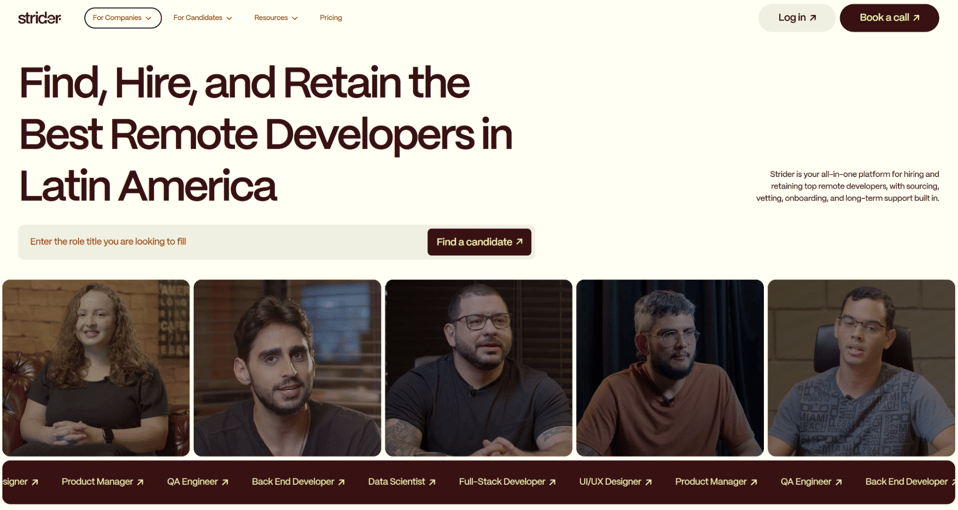 Strider is a managed hiring platform for U.S. companies that want to build engineering teams in Latin America and manage those engineers themselves. You describe the role, and about 48 hours later you get four to five human-verified profiles, all of which have undergone a five-stage screening for their English level, technical ability, and culture fit.
After that, pick the two or three worth interviewing, run your own technical round, and make the final call. In the end, your hiring cycle ends up closer to two weeks than the industry-standard 90+ days.
Hiring covers most of LATAM, including Brazil, Mexico, Colombia, Chile, and Argentina. The engineers work U.S.-aligned hours, usually four to eight hours of overlap with your team, so they're in the standup, the code review, and the Slack thread while the question is still open, rather than answering it the following morning.
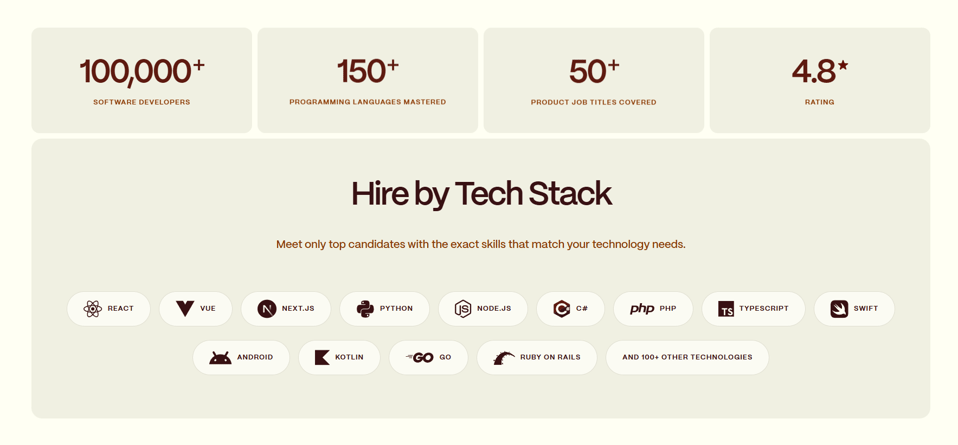 Strider draws from a network of more than 100,000 LATAM professionals across engineering, design, product, data, and QA, all of whom have at least three years of professional experience, English fluency verified by a professional teacher, and eligibility to work remotely for U.S. companies before entering the pool. That’s why 94% of Strider searches end in a successful hire despite a shortlist of just four or five candidates.
Another reason is technical vetting, which is completed by subject-matter experts and senior-level developers, depending on the role. The technical assessment runs as a live interview or a take-home depending on the role, built around a walkthrough of a real project and with live follow-up questions to weed out anyone relying on AI.
That way, your hiring decision starts with people who have already cleared Strider's screening, so you can focus on finding the personal fit rather than establishing whether someone can do the job.
Strider's full-time engineers are also dedicated to a single company and don't switch clients, so they accumulate product knowledge and work inside your Git repo, your Jira board, and your roadmap. You manage them directly as members of your own engineering org, while Strider stays out of the day-to-day and handles sourcing, interviews, and backfills without inserting itself between you and the work.
 Employing someone in Brazil or Colombia otherwise means learning foreign payroll, contracts, and tax compliance, or standing up a local entity to hold the employment relationship. Contracts, compliance, payroll, local taxes, and equipment sit with Strider instead, which also ships hardware and runs onboarding. You direct the work and skip the second vendor.
Support continues past the start date through a customer success team handling HR questions, talent development, and periodic performance reviews. An account manager stays on the relationship for its duration, available for weekly meetings or daily through your existing communication channels for anything from smoothing a cultural misunderstanding to arranging a bonus for an engineer who is outperforming to helping organize a team offsite in the region.
Strider is the right choice when you're hiring engineers you expect to keep, want to manage them yourself, and don't want to set up payroll and contracts in another country to do it. It's less suited to handing a project to a vendor and getting progress updates, or to filling a gap for a month or two. Part-time and shorter engagements exist, usually from three months up, but the pricing and the model assume people who stay.
What you get with Strider
- 48-hour shortlist: Four to five profiles, two or three interviews. A public req sends that volume to your hiring manager instead.
- Remote-work vetting: Technical assessment plus English, background, and prior remote experience, which is what separates a good engineer from a good remote one.
- Nine-country coverage: Argentina, Brazil, Chile, Colombia, Costa Rica, Mexico, Paraguay, Peru, and Uruguay, all at four to eight hours of daily U.S. overlap.
- Single-client dedication: No rotation across accounts and no shared allocation, which is the mechanism behind the 90%+ retention figure.
- In-country employment: Contracts, payroll, local tax, compliance, and hardware, without a local entity or a second vendor for the same hire.
- Named post-hire owner: A customer success team handles HR, talent development, and performance reviews, so backfills and issues have an owner outside your team.
Strider's pricing
Getting started costs nothing. Source, review, and interview candidates before you commit anything, since the commitment starts when you hire.
Pricing is a custom monthly total per role, which you can estimate using Strider’s savings calculator. Contracts are fully loaded to cover compliance, benefits, equipment, management, and the support that runs alongside the engagement, with no one-time placement fee.
If the fit turns out to be wrong, Strider works with you inside the first 30 days to find a better one.
Reviews and ratings
● Trustpilot: 4.9/5 — Based on 191 reviews
What people say about Strider
"If someone needs to ramp a team quickly and get people contributing right away, I'd recommend Strider. You still manage engineers as part of your org, but you're not dealing with constant turnover or rework." — Connor Tunney, Director of Product Optimization at Sentinel U
“Neal and the entire team is very hands on, and very thoughtful. We've been incredibly grateful to get to source talent from them. One of the engineers we've been working with for two years is easily a pillar of our company. The HR and recruiting teams are always on the ball, responsive, and genuinely helpful to us, the candidates, and even hired engineers. We've been grateful to work with them.” — Trustpilot Review
2. Revelo: Best for senior network depth
-1.png?width=958&height=455&name=image%20(3)-1.png)
Revelo is a LATAM talent platform for engineering teams making repeat hires who want sourcing volume behind each one. It boasts a network of 400,000-plus engineers, with 73% of placements landing at senior level. An in-market recruiting team returns a shortlist in about 72 hours, and hires close in 14 days on average. You can’t browse their database, though, so you see the candidates Revelo selects rather than searching the network yourself.
That network feeds three ways of working. Staff augmentation puts full-time engineers on your team under your day-to-day management. Software delivery inverts that: you hand Revelo a spec and it assembles and runs a senior squad against it, which suits a feature you need shipped without adding permanent headcount. The third is expert human data for AI code generation, covering evaluations, labeling, audits, and RL environments for frontier labs, with new evaluation capacity spun up in roughly 48 hours. All three draw on the same engineer pool.
Profiles arrive with technical background, English level, seniority, stack depth, and a recorded intro video, and you run your own technical interviews on top of that. Revelo employs through its own entities across 18 LATAM countries, handling payroll in local currency, benefits, tax, NDAs, and IP assignment without third-party partners in the chain. Coverage runs deepest in Brazil, its home market, and expanded in Mexico after the Listopro acquisition in 2025.
Engagements run month to month after a 14-day trial with no cancellation penalty, and freelance or per-deliverable contracting isn't offered at all. Converting an engineer onto your own payroll costs $40,000, reduced by tenure, which is worth considering if you plan to move them in-house eventually.
Revelo works best for teams hiring several engineers at once, or teams whose needs shift between adding people and shipping a defined piece of work. Companies whose legal policy requires a sole legal employer in-country will need to check the PEO structure against that requirement before signing.
What you get with Revelo
- A curated shortlist in about 72 hours, drawn from a network of 400,000-plus engineers
- Candidate profiles with technical background, English level, seniority, stack depth, and a recorded intro video
- Full-time engineers under your day-to-day management, or a Revelo-run senior squad built against a spec you provide
- Payroll in local currency, benefits, tax, NDAs, and IP assignment across 18 LATAM countries through Revelo's own entities
- Expert data services for AI code generation, staffed from the same engineer pool
- Month-to-month engagements after a 14-day trial, with no cancellation penalty
Revelo's pricing
Revelo doesn't publish a fixed rate card, but you can use its savings calculator to receive a price range for your monthly all-in costs. There’s no upfront cost and plans come with a 14-day free trial.
Reviews and ratings
● G2: 4.7/5 — Based on 162 reviews
3. Tecla: Best for flexible, all-inclusive engagements
.png?width=958&height=439&name=image%20(4).png)
Tecla is a nearshore talent company for U.S. teams that want recruiting and employment handled by one provider on a single hourly rate. Its network runs to 50,000-plus vetted candidates across Argentina, Brazil, Mexico, Colombia, Chile, and Costa Rica, screened for technical skills, English fluency, communication and soft skills, alongside background and reference checks.
Under staff augmentation, the engineer works inside your team on your systems and reports to your leadership while Tecla remains the Employer of Record. One hourly rate covers recruiting, vetting, payroll, benefits, equipment, and compliance, and there are no fees to start a search or run interviews, so nothing is billed until someone is working. Engagements run full-time, part-time, or hourly.
Each engagement gets a Talent and Performance Manager handling HR, benefits, equipment, and retention, which keeps one named person on the account after the contract is signed. Placements carry a 90-day replacement guarantee, so if a hire doesn't work out inside that window, Tecla sources and vets a replacement at no additional cost.
Role coverage runs well past engineering, into product, design, data and ML, DevOps, and business functions including marketing, operations, and revenue, at levels from individual contributor through executive.
Staff augmentation is also one model among several. Tecla can also place direct hires onto your own payroll and fills fractional leadership roles, so a plan that mixes embedded engineers with a part-time technical lead stays with one provider.
Tecla suits a company that wants one provider handling the search, the employment, and the HR work behind a hire, across roles that will not all be engineering. The talent pool is smaller than the region's largest networks, so a rare stack or an unusual seniority band may come back with fewer options than a broader search would produce, however.
What you get with Tecla
- Candidates screened on technical skill, English, and soft skills, with references and background verified before they reach you
- Day-to-day management, systems access, and reporting lines that stay with your leadership
- Recruiting, payroll, benefits, equipment, and compliance on one hourly rate, with no charge for the search or the interviews
- A named manager owning HR, benefits, equipment, and retention questions once the engineer starts
- Free replacement sourcing if a placement fails within 90 days
- Access to product, design, data, DevOps, and business roles through IC and executive levels
Tecla's pricing
Tecla bills an all-inclusive hourly rate, and you pay nothing until you hire. US direct-hire recruiting works differently, on a contingency fee tied to first-year base salary.
- Nearshore (LATAM) staff augmentation: $28–$58 per hour for engineers — all-inclusive hourly rate that depends on seniority, covering vetting, EOR and compliance, benefits, equipment, and ongoing success support
Reviews and ratings
● Clutch: 4.9/5 -- Based on 21 reviews
4. Near: Best for multi-function LATAM hiring
.png?width=958&height=432&name=image%20(6).png)
Near covers finance, accounting, sales, marketing, customer support, operations, design, data, and engineering, which means you can run an entire hiring plan through it instead of just the technical half of it. A company adding two SDRs, a controller, and a backend engineer in the same quarter runs all three searches with the same recruiter, who learns your standards once and applies them across functions.
Each search starts from scratch rather than from a bench. Near maintains a network of 160,000-plus pre-vetted candidates but sources fresh against every brief, so you aren't shown whoever happens to be unassigned that week. Your recruiter calibrates on stack, seniority, and team culture before sourcing begins, then handles sourcing and first-round interviews and comes back with a shortlist inside five days. Every candidate arrives with a video introduction, so a no takes two minutes instead of a scheduled call.
English is assessed in live video interviews rather than a written test, on the reasoning that technical vocabulary and unplanned questions are where fluency actually shows. Reference checks go past employment verification into how someone solved problems and held deadlines.
On the technical side, Near adapts to your coding challenges and review criteria instead of applying a fixed internal bar, and screens for AI fluency with tools like Cursor and Claude Code where a team asks for it.
Near will hold the employment relationship, running contracts, salary disbursement, tax compliance, benefits, and equipment across LATAM, or place the hire straight onto your payroll if you already have that infrastructure. Either way you set the compensation and decide when to give raises. Staff augmentation is one of five services, alongside RPO, executive search, general staffing, and standalone EOR, and placements carry a 180-day replacement guarantee.
Near works best for a hiring plan that spans functions, where engineering is a portion of it rather than all of it. The flip side of adapting to your criteria is that the technical bar is yours to set, so a team without a defined internal assessment gets less out of the model than one that already knows how it screens engineers.
What you get with Near
- Recruiters covering finance, sales, marketing, support, operations, design, data, and engineering
- A custom search per role rather than assignment from a standing bench
- A shortlist inside five days, every candidate introduced on video
- English assessed live, with reference checks that go past employment verification
- Contracts, payroll, tax compliance, benefits, and equipment across LATAM, or the hire on your own payroll
- A 180-day replacement guarantee on every placement
Near's pricing
Near doesn’t publicly list their fees, but they do provide a fee structure for each of their two plans.
- Direct Hire Model: One-time placement fee at hire, where you own payroll through an EOR or your own systems and pay nothing until you hire.
- Staffing Model: Monthly all-inclusive fee that recurs for the life of the engagement, where Near runs payroll, benefits, and compliance with no upfront fees.
Reviews and ratings
● G2: 4.8/5 — Based on 151 reviews
5. CodersLink: Best for university-sourced Mexican engineering talent
.png?width=958&height=458&name=image%20(5).png)
CodersLink recruits in Mexico and nowhere else. That single-country focus buys recruiting depth, with 26 university partnerships feeding a pool of 45,000-plus engineers and compensation guidance drawn from 1.5 million data points, so an offer gets built against real local bands rather than a regional average. Plus, Mexican engineers work on Central time, which means overlap with a U.S. team runs the full day.
Hiring runs through a framework CodersLink calls SCALE, and its point is to front-load the definition work. Role requirements get tied to your roadmap before sourcing starts, so the five-layer vetting process is filtering against your delivery stage rather than a generic seniority band. The result is a team assembled in 21 days on average without a screening round on your side.
CodersLink offers three engagement models. Embedded product teams are the default, where engineers take direction from your team and work inside your existing workflows while CodersLink carries the employment side. NearshoreRPO runs on a different footing, adding recruiting capacity instead of engineers. A CodersLink recruiter embeds in your ATS and Slack, works your existing hiring process, and commits to 20-plus qualified candidates a month, with your team keeping final interviews and the decision.
MESHubs go considerably further than either. It's a build-operate-transfer arrangement in which CodersLink stands up a dedicated Mexico engineering operation on your behalf, covering recruiting, employer branding, onboarding, local HR, payroll, performance reviews, and office space. Operational setup runs 45 days, well short of what standing up your own entity takes, and CodersLink runs the hub while the team stabilizes before transferring it onto your payroll when you're ready to own it outright.
Whichever model you pick, CodersLink ensures you find the right fit. If there’s an issue during the initial period, they replace an engineer at no additional cost, and backfills after that.
CodersLink is strong when full workday overlap is a hard requirement, since every engineer is on Central time and no placement arrives with a gap to plan around. Sourcing across Brazil, Argentina, or Colombia isn't on the table, so a company that wants the widest possible LATAM pool is buying the wrong specialization.
What you get with CodersLink
- 45,000-plus engineers to draw from, all on Central time
- Salary bands sourced from the Mexican market rather than regional averages
- Role requirements defined against your roadmap before any sourcing begins
- Engineers your leads direct, with employment administration carried by CodersLink
- The option to add recruiting capacity instead of headcount
- A path to owning the operation outright, entity and all
CodersLink's pricing
CodersLink charges a single monthly fee (no public pricing available) per engineer that bundles salary, benefits, equipment, and its management fee, with no per-hire recruitment fees.
Reviews and ratings
● Clutch: 4.7/5 — Based on 12 reviews
6. Howdy: Best for retention backed by in-country offices
.png?width=958&height=459&name=image%20(7).png)
Howdy builds LATAM engineering teams for companies where turnover has become an expensive problem. Its Howdy Houses are physical offices in 11 Latin American cities including Guadalajara, Medellín, Bogotá, Buenos Aires, Lima, and Florianópolis, where engineers work, attend professional development sessions, and meet other engineers face to face.
A remote hire who only ever sees your team on video has nothing anchoring them beyond the job itself, and the Houses give them colleagues, a routine, and a place to go that a competing offer doesn't automatically replace.
Recruiting is run by 31 full-time psychologists trained as recruiters, so communication, collaboration, and long-term fit get weighed alongside technical ability rather than after it. That way, a candidate who would pass a technical screen but struggle inside a distributed team gets caught before you spend an interview on them. Every candidate is also verified in person, a step that exists to catch AI-generated profiles and deepfaked interviews.
After placement, every professional is paired with a full-time performance coach with at least ten years of engineering management experience. The coach owns career development and alignment with your team while technical direction stays with your manager, so someone is watching for disengagement without it landing on your leads. Benefits, equipment, and structured AI training during onboarding all run through the same operation.
Employment runs through either Contractor of Record or Employer of Record arrangements depending on the country and what your legal team requires, with Howdy's own regional entities handling payroll, compliance, HR, IT management, and SOC 2 security. Placements are full-time with no end date and no minimum commitment on your side, so the arrangement holds as long as it's working and ends when it isn't.
Howdy suits a team that has already lost an engineer mid-build and wants a partner accountable for preventing the next one. The trade-off is pace, since the behavioral vetting takes four to six weeks and rules the model out if you need someone starting sooner.
What you get with Howdy
- Physical workspace in 11 LATAM cities, with events and development sessions run on site
- Recruiters who are trained psychologists, screening for collaboration alongside code
- Candidates verified in person before placement
- A performance coach on every hire, sitting outside your management chain
- Payroll, benefits, equipment, IT management, and SOC 2 security handled in-region
- Full-time placements with no end date and no minimum commitment
Howdy's pricing
Howdy offers all-inclusive plans, covering all payroll, benefits, equipment, and more, for 15% of the professional's salary.
7. Turing: Best for global reach
.png?width=958&height=454&name=image%20(8).png)
Turing draws from a worldwide talent pool that includes Latin America alongside other regions. You share the role requirements and tech stack with a talent expert, and Turing sends a shortlist of handpicked, pre-vetted profiles within 3–5 business days.
Vetting runs on a four-stage assessment covering technical proficiency, soft skills, role-specific knowledge, and job compatibility, scored largely by Turing's own models. The assessments adapt as they go, inferring what a candidate is likely to answer correctly from what they've already answered, which is how the process runs at that scale.
For AI-first teams, Turing’s Intelligence arm embeds engineers who have built and shipped for frontier AI labs, and the company runs model training and post-training work alongside placement. It has also begun recruiting non-engineers into the network, doctors, accountants, and biologists among them, because a model being trained on clinical or financial reasoning needs someone who can judge whether an answer is actually correct.
What Turing doesn't do is employ anyone. There's no Employer of Record layer, so contracts, compliance, and payroll obligations sit with you, and performance management and delivery accountability stay on your side once the match is made. Turing supplies a management dashboard and IP protection through its own virtual machine environment, but the platform ends where the working relationship begins.
Turing works when you’re hiring for a scarce skill where location is negotiable. Because sourcing is global, they only guarantee a minimum of four U.S. hours of overlap. So if LATAM placement and full-day overlap are both firm requirements, Turing’s pool will be more shallow than expected.
What you get with Turing
- Matched profiles in three to five business days, drawn from 150-plus countries
- A four-stage assessment scoring technical skill, soft skills, role knowledge, and job fit
- A two-week trial at the start of every engagement
- Engineers who have shipped for frontier AI labs, through the Intelligence arm
- Model training and post-training services alongside placement
- A management dashboard and IP protection via Turing's own virtual machine
Turing's pricing
Turing doesn't publish standard rates for developer engagements. You provide your hiring requirements and receive a custom quote after speaking with its team.
Reviews and ratings
● G2: 4.3/5 — Based on 20 reviews
How to evaluate platforms for hiring LATAM developers
Vendors in this category are not really competing on the same axis. Some will legally employ your engineer and some won't employ anyone. Some operate across the region and some in a single country. Several will sell you either an embedded hire or a managed team depending on which conversation you have.
A side-by-side feature comparison mostly produces a tie, so the decision comes down to these core considerations.
- Total employment cost: Ask for salary, statutory employer costs, benefits, platform fee, and equipment as separate lines. A single all-in monthly rate is easier to budget against and harder to audit.
- What "vetted" actually covers: Ask who runs the technical assessment and whether a person or a scoring engine does it, how English gets tested, and whether identity is verified.
- How present the vendor is in the region: Ask what they actually do there. Attending career fairs, speaking at universities, and coaching candidates through interviews are the kinds of answers that mean a vendor reaches people who aren't scrolling job boards.
- Who manages the work: Decide whether you're buying an engineer who takes direction from your leads or a team that takes a spec and reports back, because the contract and the price follow from it.
- Who legally employs the person: Employer of Record, PEO co-employment, contractor, and your own payroll are four different exposures. Ask which applies in each country you're hiring in.
- What support continues after the start date: Ask who the engineer goes to with an HR question in month six, whether anyone runs performance reviews or development plans, and how often you'd hear from the vendor once the role is filled.
- What happens if the hire doesn't work: How long the guarantee runs, whether a second search costs anything, and what moving the engineer onto your own payroll would cost later.
You probably won't weigh every criterion equally. Rank your non-negotiables before speaking with vendors, then ask the same questions during every call. You'll get a clearer comparison based on the hiring experience you need instead of whichever claim each platform promotes most heavily.
Choosing the right platform to hire LATAM developers
Start with the constraint you can't change. A role that has to sit in one specific country settles the question before anything else does. A legal requirement for a sole employer in-country rules out co-employment structures. A scarce AI or ML skill where location is negotiable points toward a global network rather than a specific country. And a hiring plan spanning finance, sales, and engineering needs breadth more than it needs technical depth.
What's left after that comes down to what happens once the search ends. Who employs the person, who supports them, and what it costs you if the placement fails are where these models diverge most, and where a sales conversation tends to cover least.
If you’re building a LATAM engineering team you intend to keep, Strider’s model was built for your team.
You interview and choose, you manage the work, and Strider carries the recruiting and the employment side so the only relationship you're running is with the engineer.
Book a call with Strider to review vetted LATAM candidates for your open roles.