

 Strider
Hiring a senior engineer in the U.S. is a months-long project. Technical roles take a median of 75 days to fill, 15 days longer than business roles, and senior seats run 37% longer than junior ones. And with AI models that can outscore most human applicants on a standard technical take-home, what looks like a perfect match after the interview may fall short once the problems go off-script.
Many teams solve both by widening the search to Latin America through a nearshore hiring platform, where the seniority is the same, the working hours match yours, and the fully loaded cost is lower. That label covers a lot of ground, though.
Some platforms only find the engineer, some vet them before you meet, and some also employ them once you say yes. Which of those models you choose decides how quickly they can start, what happens if they end up being the wrong fit, and whether they stay part of your team after the initial engagement is complete.
The ten platforms below run from full-time hires who join your team with the employment handled to a marketplace where you run every step yourself.
Top nearshore developer hiring platforms at a glance
|
Product |
Best for |
|
1. Strider |
Hiring dedicated nearshore developers who embed as full team members |
|
2. Revelo |
Fast full-time LATAM hires with payroll bundled |
|
3. Near |
Full-service LATAM recruiting beyond engineering |
|
4. TECLA |
All-inclusive staff augmentation with employment bundled into one rate |
|
5. HireLATAM |
Flat-fee one-off placements at small businesses |
|
6. Toptal |
Elite freelance specialists for project-based work |
|
7. Arc.dev |
Flexing from contract to full-time on one platform |
|
8. Lemon.io |
Startups hiring vetted contractors in 24-48 hours |
|
9. Upwork |
Do-it-yourself hiring from the widest talent pool |
|
10. Turing |
AI-matched global contractors when nearshore is optional |
1. Strider: Best for dedicated nearshore developers who embed as full team members
 Strider matches you with an engineer for the role you plan to keep filled for years, then employs them for as long as they're on your team. A full-time nearshore hire through Strider works exclusively for your company on U.S.-aligned hours, in your standups and your tools. You get the engineer without building the international employment operation behind them.
Within two days you get four or five candidates from Strider's network of 100,000+ LATAM professionals. AI does the matching against your role's requirements, and the vetting behind it is human. Every one of them has already been graded on spoken English at CEFR level by a professional teacher, interviewed live by a recruiter on fit and briefed on what you're looking for, and assessed by a subject-matter expert on a project they actually built, with that expert's written reports accompanying the shortlist. That process helps cut down the number of candidates you need to interview before you find the right one, and it’s a big part of why 94% of searches end in a hire.
Employing someone in another country is the second half of the job, composed of two equally important parts.
The first part of it is the administration. As the Employer of Record, Strider signs the employment contract, runs payroll and local taxes, provides benefits, ships the equipment, and handles onboarding, so nobody on your team has to learn another country's employment paperwork to make one hire.
The second part is the risk. The developer's local employment law applies no matter who handles the paperwork, and if the person is classified or paid wrongly, someone answers for it. As the legal employer, Strider takes on that responsibility, and the legal liability that comes with it.
After the start date a named account manager stays with your account for the whole engagement, available through your asynchronous communication channels as needed, handling jobs like changing a hire’s role or running an offsite in their region. Supporting them is the customer success team, which handles hardware, HR questions, and performance reviews that make sure your developer has everything they need to thrive. This post-hire support results in a retention rate of 90%, keeping essential team members working in your repos as long as you need them.
Strider's model makes the most sense when you're looking for a dedicated, embedded engineer who learns one codebase and is still on the team in two years. Within a few weeks that engineer is in your standup, leaving the employment side of the engagement to Strider while you focus on shipping.
What you get with Strider
- Four to eight hours of daily overlap: LATAM working hours line up with U.S. teams for most of the day, so standups, pairing, and code reviews happen live.
- 100+ technologies: Matching covers React, Node.js, Python, .NET, Go, and TypeScript, among others.
- About two weeks to a first hire: Most teams go from intake call to an accepted offer in roughly two weeks.
- Roles beyond core engineering: Strider fills AI engineering, machine learning, data, prompt engineering, marketing, product, finance, design, and QA roles.
- Nine LATAM countries: Strider hires in Argentina, Brazil, Chile, Colombia, Costa Rica, Mexico, Paraguay, Peru, and Uruguay, with availability varying by country and role.
- 30-day fit window: If a hire isn't working out in the first 30 days, Strider works with you to find a better fit.
Strider Pricing
Free to get started and free until you hire. No upfront fees, no commitment, and you pay only once someone signs.
- Fully loaded monthly cost: Compliance, benefits, equipment, and management bundled into one per-role monthly total via the savings calculator, typically 30-50% lower total cost than a comparable U.S. hire, with 42% average savings.
What are people saying about Strider
"Strider helped us avoid the typical hiring headaches and delivered candidates that actually made a difference in our team. Our 100% retention rate speaks for itself, the people we hired through Strider are still with us and performing at a high level." Kyle Gashler, Engineering Manager at Zamp
"Hiring in Brazil was perfect: friendly time zone, excellent culture fit, and a 40% lower cost compared to U.S. salary benchmarks. If you need to build out a team on short notice, Strider delivers." Mikhail Opletayev, CTPO at PetDesk
2. Revelo: Best for full-time LATAM engineers on monthly contracts
.png?width=975&height=463&name=image%20(28).png) Revelo puts a full-time engineer on your team as a contractor, on terms that run month to month. You submit a role and, within 72 hours, review a shortlist of candidates that recruiters have screened on technical skill, English, and soft skills, with a deeper technical screen available on request. Most engineers are onboarded within 14 days and work full U.S. business hours whatever their country.
Revelo puts a full-time engineer on your team as a contractor, on terms that run month to month. You submit a role and, within 72 hours, review a shortlist of candidates that recruiters have screened on technical skill, English, and soft skills, with a deeper technical screen available on request. Most engineers are onboarded within 14 days and work full U.S. business hours whatever their country.
The commitment stays short because the engagement is built to be ended or extended. You scope each role to one of three talent tiers, Average, Strong, or Elite, and the first 14 days run as a trial. If the engineer isn't right for the role, you pay nothing for that period and Revelo backfills the role. After that the contract runs month to month with no long-term lock-in.
In its engagements, Revelo acts as Agent of Record, so the engineer stays an independent contractor rather than an employee. Meanwhile, Revelo runs local payroll in local currency, benefits, taxes, equipment, and compliance from the first day. That covers 18 countries, and none of them requires you to hold an entity.
Because the engineer is a contractor, the day-to-day working relationship is yours to run, and once the 14-day trial ends there is no longer a guarantee window if the fit turns out wrong. You also can't browse the network yourself. You describe the role and wait for the shortlist. Plus, moving an engineer onto your own payroll later carries a recruitment fee, so if that's the plan, ask about those costs before your first hire.
Revelo suits a team that wants full-time engineers working within weeks and the freedom to end or extend each engagement month to month. Engagements aren't long-term by default, so it's better for sprints and other specific releases that need extra hands, with the option to keep great fits onboard.
What you get with Revelo
- 400K+ developers in a network scoped to Latin American engineering only
- Agent of Record coverage in 18 LATAM countries, including Brazil, Mexico, Colombia, and Argentina, with no entity required in any of them
- No upfront cost to start a search, with engagement lengths as short as zero to three months offered at intake
- Top 2% of applicants admitted to the network
- Work-for-hire IP terms in the contract, so everything the engineer builds is your exclusive property at no added fee
Revelo Pricing
Revelo is free to start with no upfront contract. You only pay once you hire, with a refundable security deposit equal to one month of the engineer’s payment collected at the start and credited against your final invoice.
All-in monthly rates depend on the engineer’s experience level. If you decide to hire them full-time, you’ll pay a recruiting fee that depends on their earnings and how long they’ve worked for you.
Reviews and Ratings
- G2: 4.8/5 — Based on 163 reviews
3. Near: Best for recruiting across the whole LATAM team
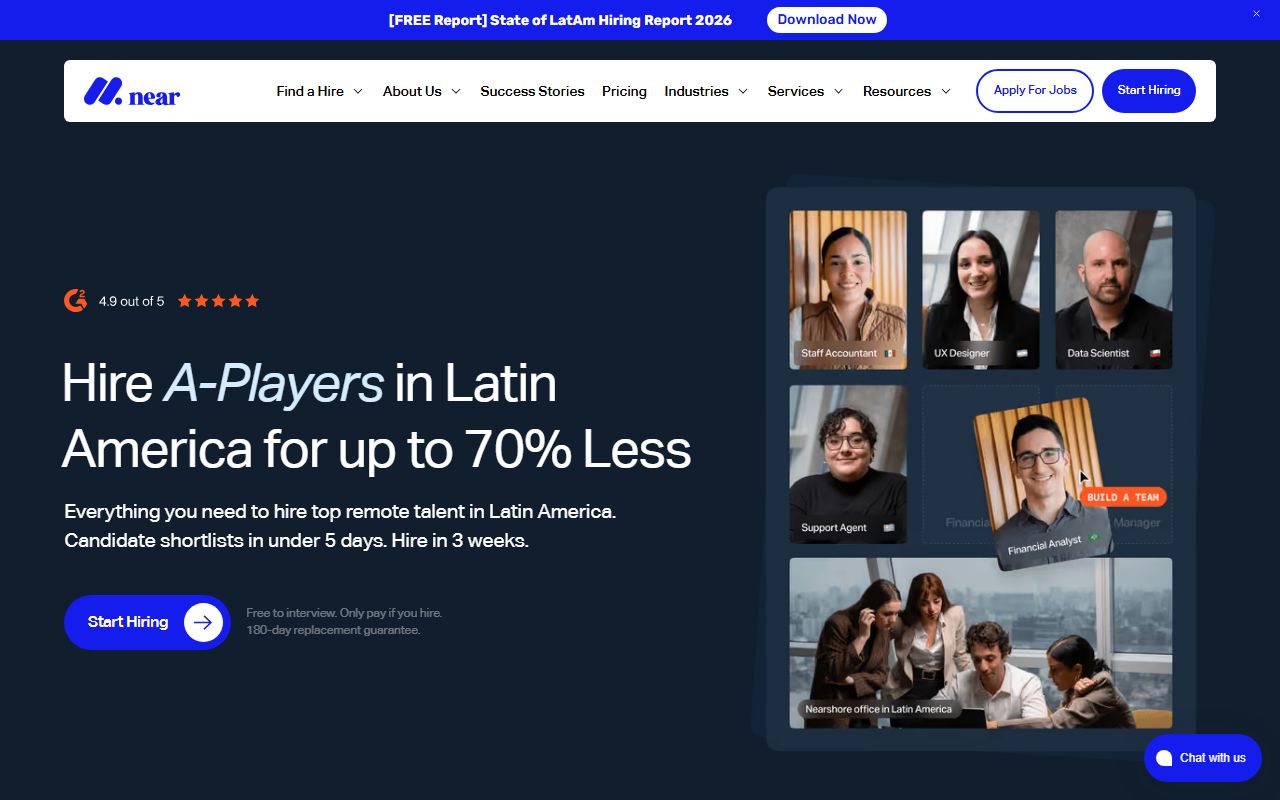 Near gives you one recruiter for every role you open in Latin America, developers and accountants alike. That recruiter covers eight departments, from software engineering to sales, finance and accounting, marketing, design, data and AI, customer support, and admin, so a company adding a developer and an accountant in the same quarter briefs one recruiter instead of qualifying two vendors.
You choose how the hire is employed. Hire directly, and the person joins your payroll or the Employer of Record you already use, with a 180-day guarantee on the placement. Or use the staffing model, where Near runs payroll, benefits, equipment, and cross-border payments through its EOR partners on one monthly invoice, and provides a new match at no added cost for as long as the engagement runs. In both, you set the compensation and decide on raises.
Every role Near places is full-time. There is no short-term engagement option and no self-serve way to browse candidates, so Near won't place a contractor for a two-month push, and any look at the network goes through the recruiter.
Near's involvement also ends at placement on a direct hire, and under staffing it continues only for payroll and HR compliance, so managing the person day to day is yours either way.
For a company staffing several functions in Latin America, Near means one recruiter, one process, and one invoice if you want it. A team whose every opening is a short engagement or a single engineer gets less from it.
What you get with Near
- 160,000+ pre-vetted candidates concentrated in Argentina, Colombia, Mexico, and Brazil, with fresh sourcing on every search
- Reference calls and international background checks on every candidate before the shortlist
- Recruitment process outsourcing for volume hiring and executive search for director-level and above, from the same team
- Benefits design and management, including healthcare and PTO, under the staffing model
- 180-day replacement guarantee on direct hires, and replacement coverage for the duration of the engagement on the staffing model
Near Pricing
Near doesn't publish fee amounts for either model. Interviewing candidates is free, and you pay only when you hire.
- Direct hire: Contact for pricing — one-time placement fee, with published salary bands as budget anchors
- Staffing model: Contact for pricing — monthly invoice combining the hire's salary and Near's fee, with a stated no-hidden-markup policy on the split.
Reviews and Ratings
- G2: 4.8/5 — Based on 153 reviews
4. TECLA: Best for full-time, part-time, or hourly nearshore developers
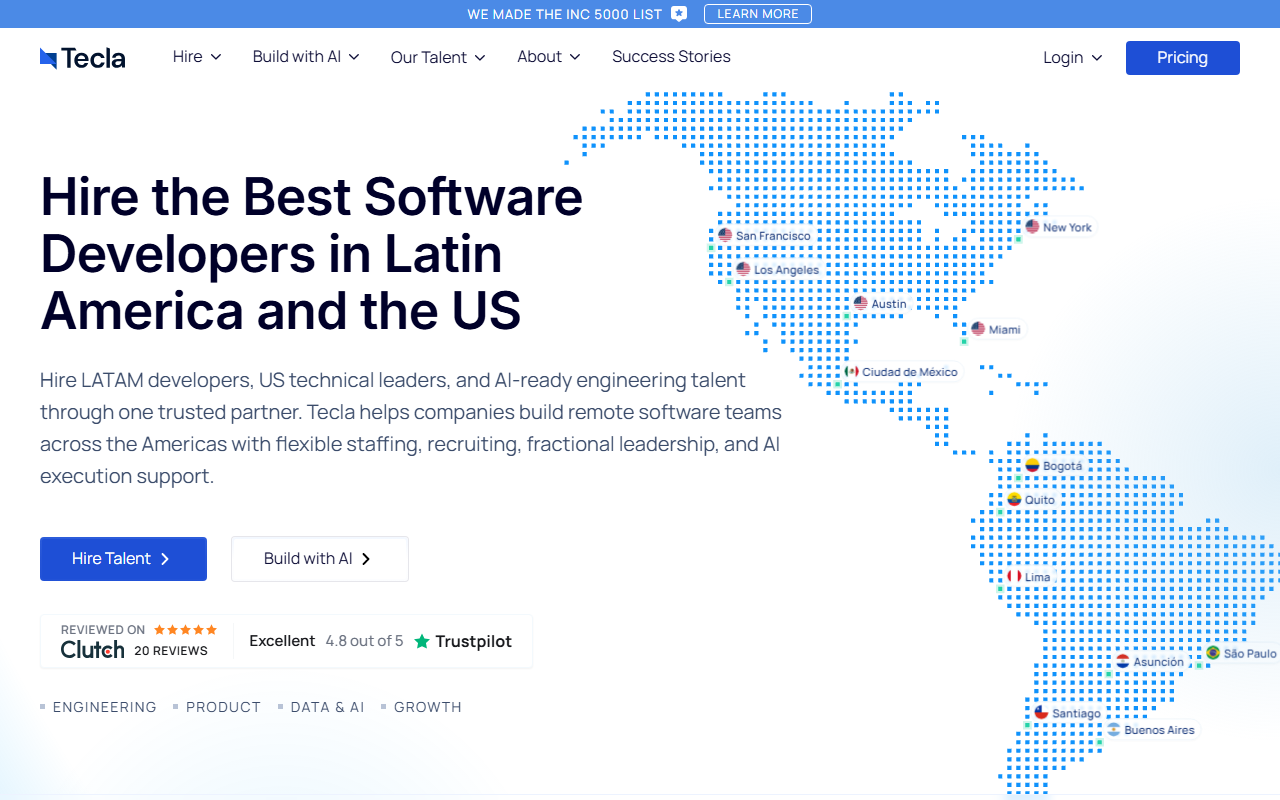 TECLA supplies nearshore developers as staff augmentation, employed by TECLA in their own country, on engagements you end or extend as the work changes. They run full-time, part-time, or hourly on rolling monthly terms with no multi-year lock-in, and because TECLA is the employer of record, a two-person addition for a six-month build needs no entity, local payroll, or long commitment from you.
Screened candidates arrive within five to seven days and most start within two to three weeks. Each has passed AI screening, a technical assessment with coding challenges and system design, a 45-minute recruiter interview on English and culture fit, and a check of three or more references before you see them.
TECLA handles the legal, contracts, compliance, payroll, benefits, and tax obligations, ships the equipment, and provides success support for the length of the engagement, while your engineering lead directs the day-to-day work. If a placement doesn't work out in the first 90 days, TECLA finds a new match at no added cost. Scaling the team down at the end of a project is then a notice under your contract with TECLA rather than a termination under another country's employment law.
Converting a developer to your own direct hire is possible after 6 to 12 months, but the terms vary per contract. Some engagements convert at no charge, while others incur a fee after 12 months of billed service, so if that’s something you plan to consider, negotiate those terms at the beginning of the engagement.
For a team whose developer count moves with its project load, TECLA lets the count move with it, with no employment operation to unwind when it drops. If you goal is a long-term hire, converting a TECLA hire may end up more expensive than starting with a long-term platform from the start.
What you get with TECLA
- 50,000+ vetted LATAM professionals across 18 countries
- Roles beyond engineering, including product, design, data and ML, DevOps, marketing, operations, and revenue, through executive level
- A web dashboard for reviewing and interviewing shortlisted candidates
- Fractional executive and leadership placements from the same team
- Direct-hire recruiting on contingency for U.S. or LATAM roles, with the relationship ending at placement
TECLA Pricing
TECLA prices its nearshore work at an all-inclusive rate, and nothing is due until you actually make a hire.
- Nearshore staff augmentation: $28/hr average across junior, mid, and senior levels, all-inclusive.
- Nearshore development team: $4,500-$8,500 per developer, per month — by role and seniority
- U.S. direct-hire recruiting: Contingency fee of 15%-25% of first-year base salary, pay only on hire.
Reviews and Ratings
- Clutch: 4.9/5 — Based on 21 reviews
5. HireLATAM: Best for placing one developer you'll contract with directly
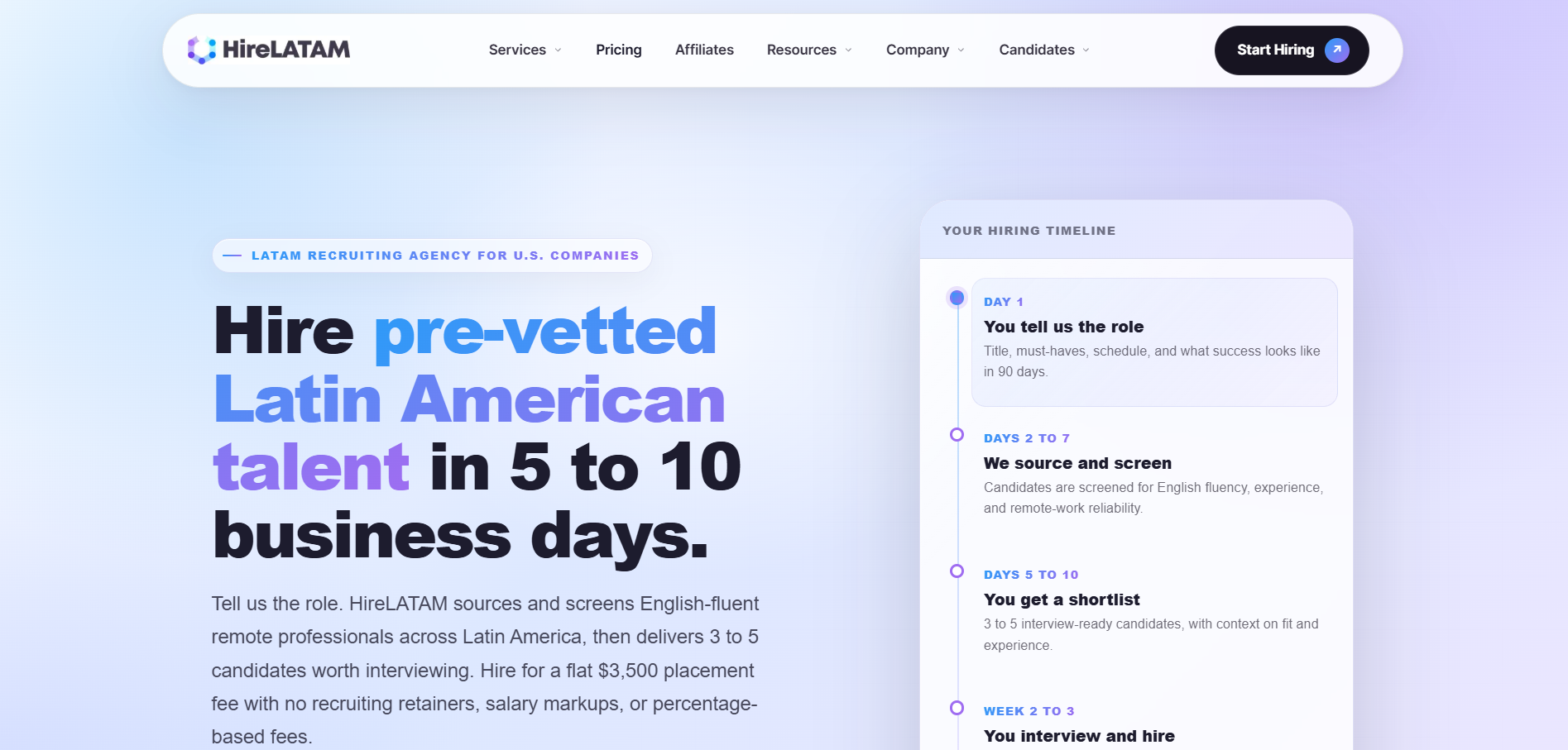 HireLATAM is a recruiting agency rather than a platform. You brief the role, its recruiters run the search across Latin America, and you interview the finalists and make the hire yourself. Once the placement closes, the developer contracts with you directly, and HireLATAM steps out of the relationship.
The recruiting moves quickly. Someone follows up within one business day of your intake, most searches produce a shortlist of interview-ready candidates within five to ten business days, and a typical hire closes in two to three weeks if your interviews keep pace. Time zone is a sourcing filter from the start, so the finalists you meet already overlap with a U.S. workday, and their English has been checked in speech and writing before you see them.
The hire is an independent contractor under a services agreement with you, so no entity, Employer of Record, or work visa comes into it. Paying the contractor each month stays with you as well.
HireLATAM’s vetting stops short of code, though. It confirms that a candidate's background checks out and their English holds up, but it runs no coding tests or architecture assessments, so your team designs and runs the technical evaluation. That works when you have an engineer who can own that evaluation, but if your team is already at maximum capacity, finding the time to vet a new hire isn’t always possible.
HireLATAM fits a small business making one hire at a time, with an engineer on staff to run the technical round and a way to pay a contractor abroad already in place. Without either, you'll need to add both before this model works.
What you get with HireLATAM
- Developer and IT placements across React, Next.js, Vue, Node, Python, Java, .NET, AWS, GCP, and Azure, as one of 10 role categories
- Sourcing across Colombia, Mexico, Argentina, Costa Rica, Honduras, El Salvador, and more, selected by role fit and time zone
- Screening for relevant experience, English fluency, reliability, remote readiness, and U.S. business-hour overlap
- 90-day replacement guarantee, extendable to 6 months with the payroll admin add-on
- No salary markup, with 100% of compensation going to the hire
HireLATAM Pricing
HireLATAM charges a one-time flat fee per successful placement, and only the deposit is at risk to start a search.
- Flat placement fee: $3,500 per successful placement, structured as a $500 deposit to start the search and $3,000 due on hire.
- Payroll admin add-on: $149/month for post-hire payment coordination support (not payroll ownership or EOR).
Reviews and Ratings
- Clutch: 4.9/5 — Based on 6 reviews
6. Toptal: Best for getting a specialist contractor working within days
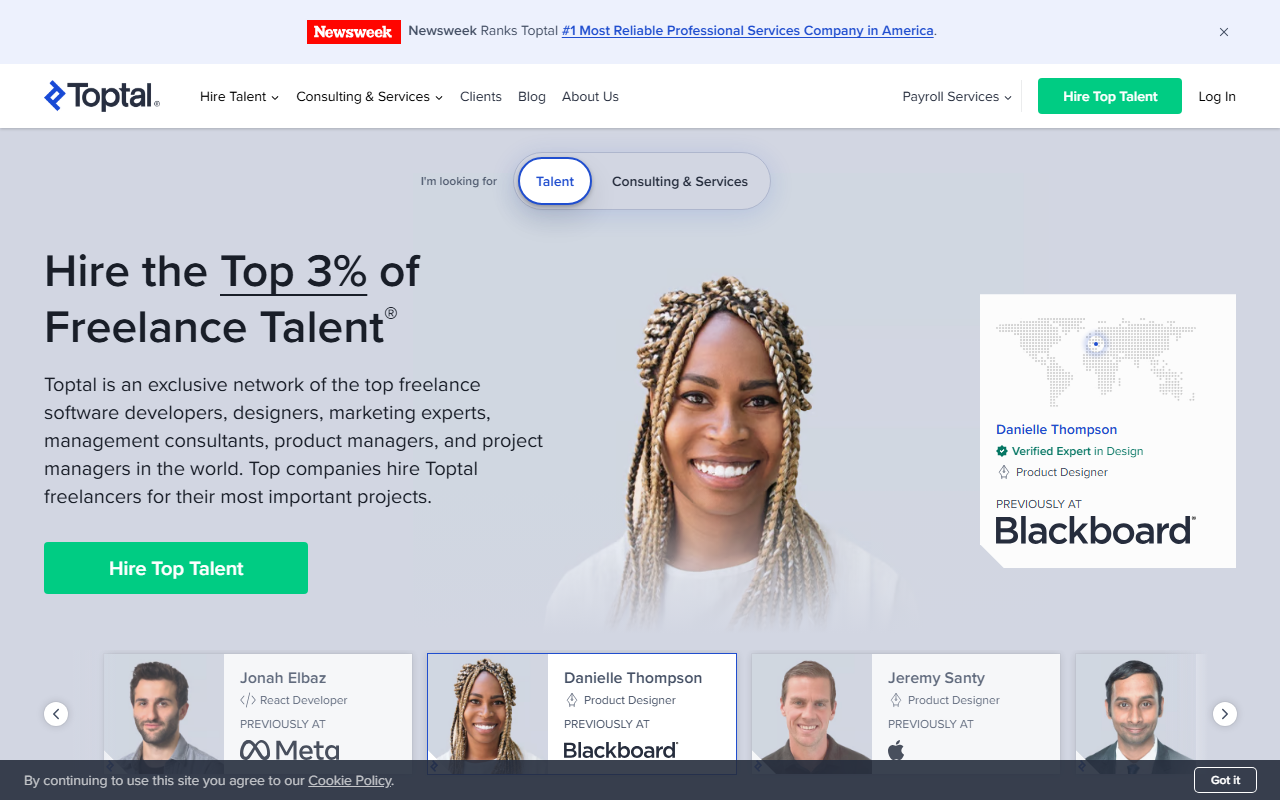 Toptal can have a senior specialist working on a scoped engagement within days. You describe the role to a matcher, who introduces a candidate in under 24 hours on average, and 90% of clients hire the first person introduced. Everyone in the network came through a published five-step screen that accepts fewer than 3% of applicants.
The people you find on Toptal are independent contractors. In a standard engagement Toptal isn't the employer of record, so you handle compliance and day-to-day oversight, and contractors roll off when the work ends. It sells payroll and global employment through HireGlobal, but that's a separate product for workers you've already sourced.
Importantly, Toptal has no LATAM program. Its pool is global, and the only geography control is a time-zone filter on the talent search, so nearshore hiring on Toptal means narrowing a worldwide pool to Americas hours yourself, with no minimum overlap guaranteed once you do.
The sub-24-hour match also depends on someone in the network already fitting the request. When nobody does, sourcing and screening a new specialist takes one to three weeks.
Toptal excels when the job is a project, an interim engagement, or a scoped build and you want a screened specialist working by next week on hours you set. A permanent nearshore role that you expect someone to hold for years isn't what its engagements are built for, since each one is set up to end.
What you get with Toptal
- Public talent profiles with expertise tags, years of experience per skill, a portfolio, and live availability, viewable before contact
- No-risk trial of up to two weeks with up to three candidates per position, billed only if you're satisfied
- Hourly, part-time (20 hours a week), or full-time (40 hours a week) engagements you can scale up or down
- Matching, billing, and invoicing run through Toptal, leaving you to manage only the contractor's day-to-day work
- Talent across seven verticals, covering developers, designers, marketing experts, management consultants, project managers, product managers, and sales experts
Toptal Pricing
Toptal pairs a flat platform subscription with talent rates that aren't published anywhere on the site.
- Platform subscription: $79/month flat fee — charged if you proceed with talent matching.
- Talent rates: Contact for pricing — talent set their own hourly rates, with invoices roughly twice a month on Net 10 terms
Reviews and Ratings
- G2: 4.7/5 — Based on ~260 reviews
7. Arc.dev: Best for flexing from contract to full-time on one platform
.png?width=1280&height=800&name=image2%20(1).png) Arc.dev lets you start a developer on an hourly contract and convert them to a full-time hire on the same platform once the fit is proven. Freelance matches arrive within days, and permanent placements close in about 14 days on average.
Arc.dev lets you start a developer on an hourly contract and convert them to a full-time hire on the same platform once the fit is proven. Freelance matches arrive within days, and permanent placements close in about 14 days on average.
A contractor who has spent two months in your codebase is often the strongest candidate you will see for the permanent version of the role, and losing them to a fresh search means repeating an evaluation you have already run. On Arc you convert that person on the strength of the work they have shipped rather than on how they interview. Contract-to-hire is written into Arc's freelancer agreement, with a notice period and a wind-down of about 30 days before the developer moves onto your payroll.
The two tracks aren't the same service, though. Freelance hires come from Arc's vetted network, which screens English fluency and remote readiness alongside technical skill, and come with a risk-free trial of up to two weeks.
The full-time plan recruits from a worldwide pool of more than 20 million candidates with a dedicated recruiter, custom sourcing, and ATS integration. That's a recruiting service rather than a pre-screened network, so the four-stage screen applies to the freelance side and full-time candidates come through recruiter sourcing.
But you’re the employer either way. Freelancers are contractors you manage, and a full-time hire outside the U.S. is employed through one of Arc's EOR partners or your own entity, which means a second vendor and a second contract before the person can start.
Latin America is also one region in a global pool with no nearshore program behind it, so the overlap you get is whatever the listing requested. A team that already runs an EOR, or is hiring in the U.S., loses nothing to either.
For a team that wants to see a developer work before committing to a permanent hire, Arc turns the conversion into a contract step instead of a second search. If you want them employed as well, Arc leaves that part to your EOR.
What you get with Arc
- 450,000 talent across 190 countries with region and country filters, including a Latin America view
- Four-stage vetting to a stated top 2%, with published pass rates of 55%, 14%, and 2% by stage
- HireAI matching that delivers candidates in seconds
- ATS integration on the full-time plan, with a live Greenhouse connector
- Required time-zone overlap stated on each job listing, with every candidate's UTC offset shown on their profile card
Arc Pricing
Arc charges nothing until you hire, then fees follow two tracks depending on the engagement:
- Freelance hires: $15 to $110+ per hour by role, expertise, and location
- Full-time hires: one-time placement fee of 20% of the candidate's first-year compensation, with a fixed $30,000 fallback fee if compensation can't be verified.
- Contract-to-hire conversion: An unpublished additional fee applies when you extend a freelance engagement into a full-time hire
Reviews and Ratings
- G2: 4.8/5 — Based on 18 reviews
8. Lemon.io: Best for matching a senior contractor within a day for sprint work
.png?width=975&height=533&name=image%20(15).png) Lemon.io puts a senior contractor on a defined engagement within days. Describe the role and a technical analyst hand-picks one to three profiles, each with a written note on why the developer fits, and 80% of those matches arrive inside 24 hours. Engagements run part-time or full-time at 20 to 40 hours a week and are billed hourly with no minimum, so a two-month push can end when the work ships.
Lemon.io puts a senior contractor on a defined engagement within days. Describe the role and a technical analyst hand-picks one to three profiles, each with a written note on why the developer fits, and 80% of those matches arrive inside 24 hours. Engagements run part-time or full-time at 20 to 40 hours a week and are billed hourly with no minimum, so a two-month push can end when the work ships.
The network is small on purpose. Roughly 1 in 100 applicants makes it onto the platform, after a pre-screen with a technical task, a recruiter interview, and a live technical interview scored on shared scorecards that other interviewers cross-review. That leaves just over 1,500 developers across 40+ countries in Europe, Latin America, the U.S., and Canada.
As a contractor marketplace, Lemon.io doesn't employ the developer, but it does run the commercial side of the engagement. The contract, the NDA, invoicing, and payouts all go through the platform, and if a developer underperforms or goes quiet, Lemon.io matches you with a new one within 24 to 48 hours. Average time from request to a developer starting work is one to two weeks.
Because there is no employer of record, classification and supervision are yours, and Latin America is one of four regions in the pool rather than its focus. Matches are filtered on time zone, but no minimum overlap is guaranteed, so confirm working hours before the engagement starts.
Despite consisting of mostly senior developers, Lemon.io’s thin pool also means specialized roles may be harder to fill, especially if you’re hiring more than one person at a time.
For sprint and contract work that needs a senior engineer soon, Lemon.io matches one within a day, has them working within a week or two, and lets you release the hours when the work ships. A role you plan to keep for years needs someone to employ the person, and Lemon.io doesn't.
What you get with Lemon.io
- Technical interviews that watch how a candidate uses AI tools alongside live coding and system design
- A client dashboard for requests, developer profiles, subscriptions, and billing history
- Work-for-hire IP terms, so you own all deliverables on full payment
- A named Lemon.io manager on each engagement who handles rematches and questions
- Unused hours roll over to the next billing cycle on part-time and full-time engagements
Lemon.io Pricing
Lemon.io charges a single hourly rate per engagement, with no upfront fee and payment only for work delivered. The total cost depends on their tech stack, seniority, and what the project needs.
Reviews and Ratings
- G2: 4.7/5 — Based on 59 reviews
9. Upwork: Best for do-it-yourself hiring from the widest talent pool
-1.png?width=1896&height=902&name=image9%20(1)-1.png) Upwork hands you the whole search, across more than 18 million freelancers in 180 countries, with no recruiter or matcher between you and the candidate. Proposals arrive within hours of posting a role, and every candidate profile shows a contract history you can check yourself, so you can start qualifying LATAM developers before the first conversation.
Upwork hands you the whole search, across more than 18 million freelancers in 180 countries, with no recruiter or matcher between you and the candidate. Proposals arrive within hours of posting a role, and every candidate profile shows a contract history you can check yourself, so you can start qualifying LATAM developers before the first conversation.
When an outside recruiter owns sourcing, your first look at a candidate is whoever cleared someone else's technical bar. On Upwork you set it yourself. You search the pool directly, filter by location and time zone to assemble a LATAM-only slate, invite the specific developers you want proposals from, and then run interviews and screening the way your team already evaluates engineers.
You can also pick the contract type to match the work. Run a fixed-scope project for a trial or an hourly contract for an open-ended role, with contracts, time tracking, and payments going through the platform either way.
What Upwork doesn't do by default is judge whether someone can code. Identity is verified, and work history is visible on their profile, but nobody has assessed technical ability before that proposal lands in your inbox. Reviewing proposals, running technical evaluations, and checking references are all your team’s responsibilities.
Upwork does sell access to Expert-Vetted talent, screened for technical expertise and soft skills, but that filter is only available on the Business Plus plan. The AI shortlisting also works in a similar way, with Uma the AI assistant delivering a curated shortlist in under six hours on Business Plus and limited access on Basic.
An engineering leader who wants to screen candidates personally and draw from the widest possible pool gets that on Upwork, at the cost of the hours self-managed screening takes. If you'd rather receive a vetted shortlist, or can't spare those hours, the open model works against you.
What you get with Upwork
- Direct Contracts for bringing freelancers you found elsewhere onto the platform to manage and pay in one place
- Free job posting to a global pool with verified work histories and client reviews, plus talent invitations per post
- Mobile and desktop apps, including a desktop time-tracking app for hourly contracts
- Funded milestones on fixed-scope contracts and work-diary payment protection on hourly billing
- A compliance ladder for engagements that grow, including Any Hire contractor management with $50,000 in misclassification protection, and Upwork Payroll for U.S. employees
Upwork Pricing
Upwork is free to post on, with fees charged as a percentage of each payment to your freelancer plus a one-time fee per new contract.
- Basic: A 5% marketplace fee on every payment, dropping to 3% for eligible U.S. clients paying from a checking account.
- Business Plus: A 10% fee, or 8% with the same U.S. checking account discount, plus Expert-Vetted access, unlimited AI shortlisting, and 30-day payment terms for eligible U.S. companies.
- Contract initiation fee: $0.99 to $14.99 per new contract on Basic, charged at first payment or first milestone funding, non-refundable, and payable again for every new contract even with a freelancer you've hired before. Business Plus waives it except on contracts under $100, where up to $4.99 applies.
Reviews and Ratings
- G2: 4.5/5 — Based on 3,219 reviews
10. Turing: Best for filling several engineering roles at once from a vast global pool
 Turing matches every role you open against a pool it tested before you called, so three open roles become three shortlists instead of three separate first-round funnels. The pool is global, the top 1% of more than 3 million engineers who have applied, and the specialization coverage runs to 100+ skills.
Screening a pool that size yourself would put your senior engineers back into first-round calls. Turing handles that layer with test-based vetting, scoring candidates on technical depth, seniority signals like project impact, and communication before a profile ever reaches you, and hand-selected profiles arrive in about four days.
Every engineer commits to at least four hours a day of overlap with your team and a daily standup run through Turing's own Workspace tool, and that much holds even when the person is far away. Your developer could be ten time zones away, with the overlap falling at 7am your time and 9pm theirs, because Turing has no LATAM program or country list. You specify nearshore proximity in the brief yourself.
Turing also places contractors and doesn't employ or supervise anybody, so worker classification and daily oversight are yours. A team that already works async and writes decisions down can take that on without much extra work.
Turing pays off when you have several open roles and can tolerate distance, or one role in a specialty that's thin in any single region. For one nearshore engineer in your own time zone, with someone else employing them, Turing is the wrong fit.
What you get with Turing
- AI matching that ranks pre-scored profiles against your role, with hand-selected profiles delivered for review
- 57-question seniority assessment across project impact, engineering excellence, communication, people, and direction
- Tests across programming languages, data structures, algorithms, and system design before a profile enters the pool
- Contractor payments routed through Deel
- Three-week trial, with the trial weeks billed only if you continue
Turing Pricing
Turing quotes each engagement individually by role and seniority, and if you continue past the three-week trial, the first invoice covers those weeks too.
Reviews and Ratings
- G2: 4.3/5 — Based on 20 reviews
How to evaluate different options for nearshore developer hiring platforms
Start with what each platform actually sells. Some place a full-time engineer who joins your team, others rent you a contractor by the hour, and a few only run the search and hand the hire to you. Billing, control, and legal risk all follow from which of those you're buying, so settle it before comparing anything else.
- Engagement model: Pin down who employs the developer. A platform acting as Employer of Record takes on payroll, taxes, and misclassification risk, while a marketplace leaves all three with you. This also tells you how long the arrangement is built to last, since an embedded hire is meant to stay, and a staff augmentation contract is meant to end.
- Total cost: An hourly rate hides most of the bill. Estimate the fully loaded monthly cost instead, including salary, benefits, compliance, equipment, and platform fees, plus any conversion fee if you later take the developer in-house.
- Vetting substance: Acceptance rates make good marketing and tell you almost nothing. Ask whether anyone tested the candidate's spoken English in a live conversation, whether they wrote code in front of a human, and who ran that interview. A recruiter scoring a rubric is not the same as a senior engineer asking follow-up questions.
- The speed claim runs on: "Hire in 48 hours" can mean a shortlist hits your inbox, or it can mean somebody starts work. Those are weeks apart. Get the vendor to say which milestone they're measuring.
- Support after the offer letter: Sourcing is the easy half. Payroll, compliance, benefits, equipment, onboarding support, ongoing HR, and the terms of the fit guarantee decide whether the hire still works six months in, so ask which of those the platform handles and which your ops team picks up.
- Security and IP: Confirm who owns the work product, how NDAs and IP assignment are handled across borders, and what device and access controls the platform enforces before a remote engineer touches your codebase.
- Integrations with how you already work: A developer who can't get into Jira, GitHub, and Slack on day one isn't productive on day one. Ask who provisions access during onboarding and how candidate records reach your ATS.
Weight all of this by how long you expect the engineer to stay. For a three-month project the rate matters most. For someone you want on the team in two years, everything after the offer letter matters more.
Strider: The best platform for hiring a nearshore developer you plan to keep
Once you know how long the person should stay, the platform type follows.
For a sprint, a freelance network or a marketplace lets you size the engagement to the work and end it when the work is done. A recruiter that places and steps back works when you already run international payroll. Hiring across functions calls for a partner that recruits beyond engineering.
The role you plan to keep is what Strider is built for. You pick who fits your team. Strider is the legal employer, so there is no entity to open, and no classification risk sits with you. Support after the start date goes both ways, to your hire and to you, to keep the engagement running smoothly.
For a side-by-side against freelance marketplaces or outsourced dev shops, you can see how Strider compares across hiring models first.
If your roadmap is waiting on engineers nobody has had time to screen, book a call today and tell us about the role. It's free to get started and free until you hire.