

 Strider
For years, Turing was a quick way for U.S. companies to put a remote software engineer on their team. It kept a large pool of pre-vetted developers, matched your role against it within days, and engaged the engineer you chose as a contractor under your direction.
Turing's business has since moved to AI. As of September 2026, it sells training data and model evaluations to frontier AI labs, and it builds and runs AI agents for large enterprises. Developer hiring is no longer its main line of work.
Whether you hired through Turing or had it on a shortlist, that's reason enough to look at other ways to make the same hire.
A few of the ten alternatives below stay close to Turing's model, with a global pool of vetted contractors you direct. The rest hire in one region, leave the screening to you, take over the recruiting or the build, or employ the engineer for you.
Can you still hire developers through Turing?
Yes, by request. Turing takes inquiries for engineers through a contact form that promises pre-vetted profiles in as little as 72 hours and a no-risk trial. Under its client terms, those engineers are independent contractors, employed by neither Turing nor your company. They work under your direction, Turing pays them, and you pay Turing.
For a project with an end date, that can work well. For a role you plan to keep for years, it means the engineer is nobody's employee, and you handle local compliance and classification yourself.
Turing's other offers are built for different work. Its forward-deployed engineers embed in a company to build AI agents, which Turing then deploys and runs on its own platform. If AI agents are what you need, that's an option, but it's a delivery engagement with Turing's engineers owning the build, and it doesn't put a developer on your team.
Top Turing alternatives at a glance
|
Product |
Who it's for |
Key strengths |
Hiring model |
Talent location |
Pricing |
|
1. Strider |
Teams replacing Turing for roles they plan to keep for years |
Expert vetting against your role Employment through Strider as EOR A named account manager |
Curated hiring with employment |
Latin America |
Monthly rate per hire, nothing until you hire |
|
2. Toptal |
Teams that need one senior specialist working this week |
Matched by someone in your field A trial with up to three candidates Hourly to full-time |
Curated freelance network |
Global (100+ countries) |
Specialist's hourly rate plus a monthly subscription |
|
3. Arc.dev |
Teams that want to see a developer's work before hiring them |
Freelance starts in about 72 hours Conversion terms set in advance A full-time track |
Freelance and full-time, contract-to-hire |
Global (190 countries) |
Hourly for freelance, a share of first-year pay for full-time |
|
4. Revelo |
Teams whose engineering needs change from quarter to quarter |
Agent of Record on each contract No cancellation penalty 400,000+ engineer network |
Contractors under an Agent of Record |
Latin America (18 countries) |
All-in monthly rate by seniority ($4,600 to $10,700) |
|
5. HireDevelopers by CloudDevs |
Teams whose need for extra capacity is measured in weeks |
No minimum Weekly billing A seven-day trial |
Contractors on weekly terms |
Latin America, plus Europe and Asia |
Hourly, billed weekly ($45 to $75) |
|
6. Upwork |
Teams with the time to run their own screening |
Competing bids on every post Job Success Scores and badges Escrow on fixed-price work |
Open freelance marketplace |
Global (180 countries) |
A share of freelancer payments (3% to 10%) |
|
7. Andela |
Enterprises that also want to retrain their own engineers |
Individual engineers or managed teams AI training for your staff Agent of Record contracting |
Talent deployment plus training |
Global (135+ countries) |
Custom quote |
|
8. BairesDev |
Teams handing off a whole build |
A signed SLA A certified Scrum Master and Product Owner Design and QA roles included |
Managed delivery |
Latin America |
Custom quote, scoped in discovery |
|
9. Gun.io |
Teams without time to review a contractor's code |
Code and architecture audits Senior-engineer vetting Contract-to-hire |
Contract talent with technical oversight |
Americas, Europe, and Asia |
Retainer at the developer's rate, a fee to hire full-time |
|
10. Near |
Companies with several roles open at once, across functions |
One recruiter, a separate pipeline per role Engineering and business roles Works alongside your own recruiters |
RPO and staffing |
Latin America |
Placement fee, or a monthly share of pay |
1. Strider: Best for long-term LATAM engineers with role-specific vetting and employment handled
 Strider matches you with an engineer in Latin America who's been evaluated against the role you're filling, then employs them as a long-term, embedded member of your team.
Candidates come from Strider's network of 100,000+ professionals in nine countries, from Mexico to Argentina, so their working day overlaps yours by four to eight hours. Everyone in it is also already cleared to work remotely for U.S. companies.
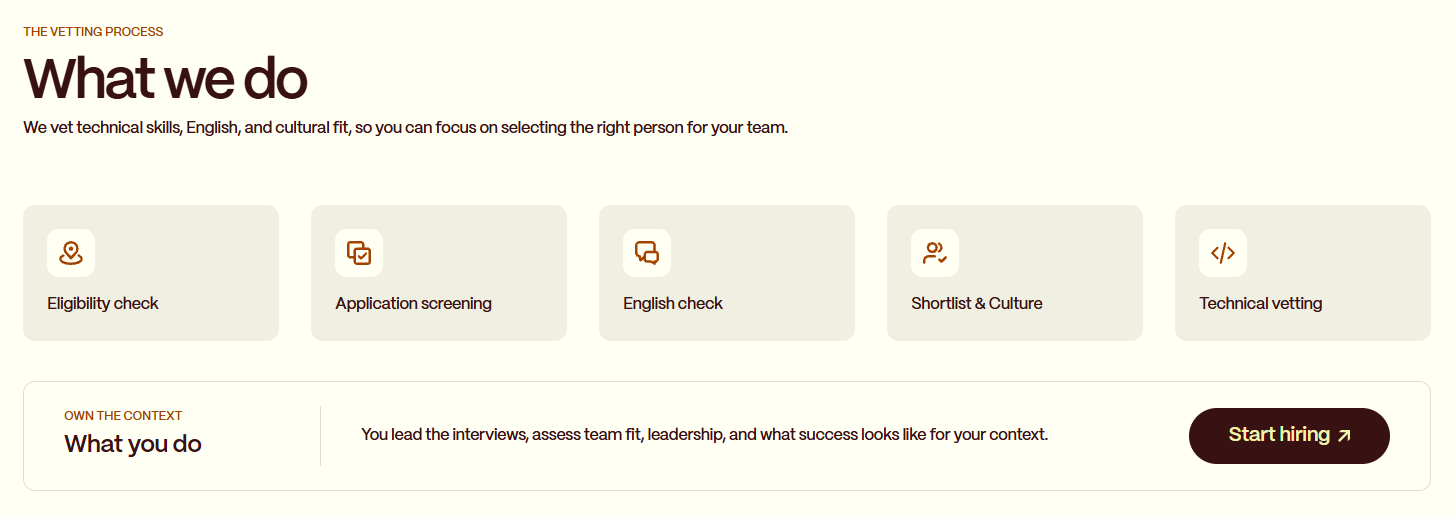 Everything after that is specific to your role. Your search starts with an intro call about the job, its seniority, and who you want in it. AI screening then narrows the network to people at that level with the right skills, and people make every vetting decision from there.
A recruiter screens candidates on your stack with questions written for the role, and a professional English teacher grades a recorded speaking assessment on the CEFR scale. A live interview then covers motivation and how the person works with a team.
Four or five candidates reach you within two days of the intro call. Before your final interviews, a subject-matter expert walks through a project each candidate shipped and pushes on the decisions behind it in real time. That way a candidate can't lean on AI for all the answers.
Anyone who the expert can't vouch for goes no further, so you can be confident anyone who reaches the shortlist is capable. And every vetted candidate comes with the expert's write-up that tells you what to explore when you interview them.
With every finalist tested against your role by someone who does that work, 94% of Strider searches end in a hire.
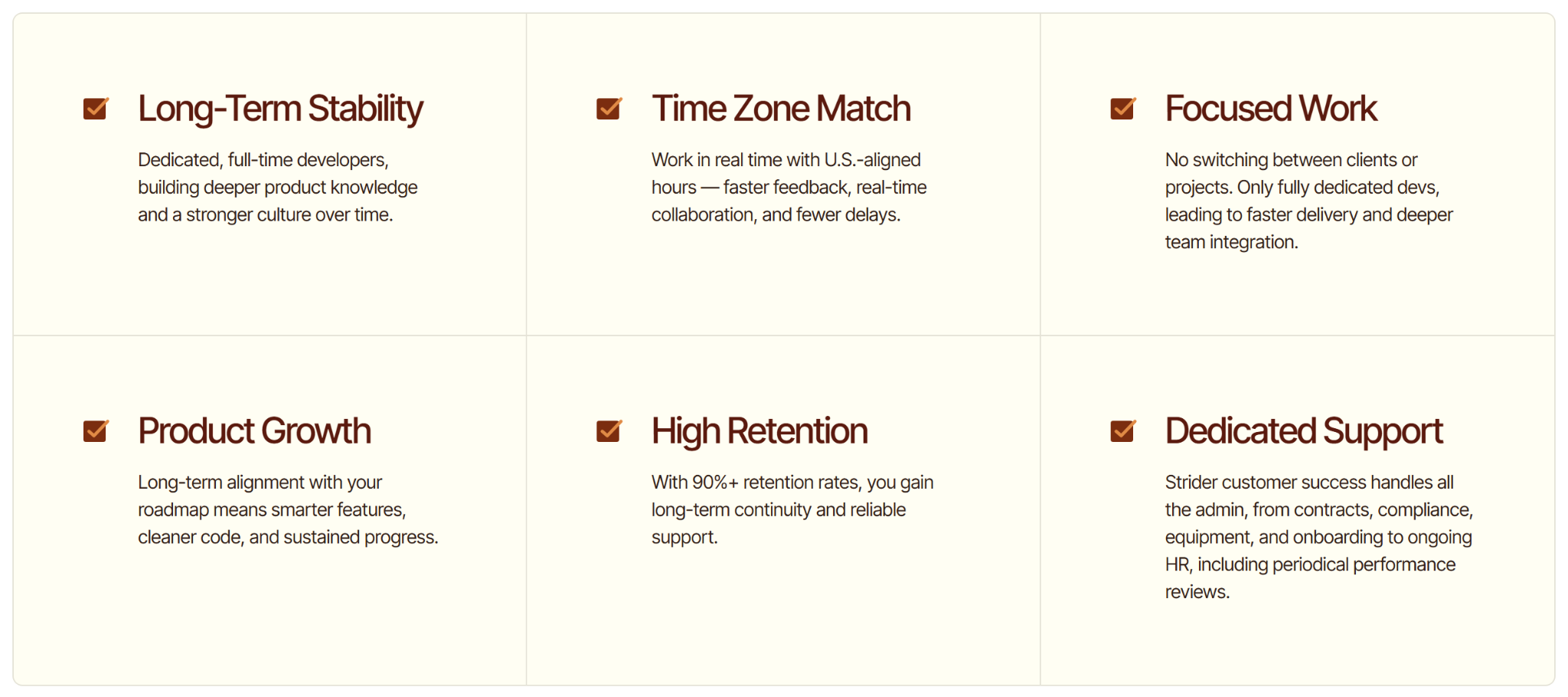 Once you've chosen, Strider becomes the Employer of Record (EOR). It holds the contract and handles payroll, local taxes, benefits, and equipment, so you don't need an entity in the engineer's country or a separate employment provider. It also takes on the compliance risk. On the other side, Turing engages its engineers as independent contractors, and you handle their classification and local compliance yourself.
A named account manager stays with you through the whole engagement, reachable on Slack or email. They're who you call when a hire's performance needs a development plan, when you want a pay benchmark before a raise, or when an engineer without reliable broadband needs Starlink.
Behind them, customer success handles hardware, onboarding, HR questions, and periodic performance reviews. Full-time hires work with your company alone rather than rotating between accounts, and with fit screening up front and that support afterward, retention on Strider hires runs past 90%.
Strider fits best when the role has no end date and you want the hiring and the employment behind it handled. It isn't built for a specialist you need for three weeks, a project you want someone else to deliver, or a hire outside Latin America.
What you get with Strider
- AI-ready LATAM talent: Strider covers AI engineering, machine learning, data, and prompt engineering roles alongside its core network.
- Engagement options: You can hire long-term full-time, long-term part-time, or short-term full-time from the same network.
- 30-day fit window: When a match isn't right in the first 30 days, Strider's team works with you to find a better one.
- Live technical follow-ups: The expert's unscripted questions catch candidates who can't explain their own work or who give AI-generated answers.
- Roles past engineering: Strider also matches you with product managers, designers, QA analysts, marketers, and finance hires.
- 100+ technologies: Searches run across more than 100 technologies, including React, Node.js, Python, Go, and TypeScript.
Strider's pricing
Opening a search and meeting candidates cost nothing, and billing starts only once you hire. From then on, you pay one fully loaded monthly rate per hire, which covers the engineer's pay, benefits, equipment, compliance, and Strider's support.
Strider's savings calculator gives an estimate for a role, and the actual rate depends on the role and seniority, the engagement type, and the engineer's country and stack.
What customers are saying about Strider
"The very first candidate we hired exceeded expectations and became a role model for our team. Strider's continued support made the process easy, including onboarding and performance management." — Keivan Shahida, CEO, Response
"Strider's interview process is very simple and efficient. Interviews can be a heavy burden on the team; Strider helped us make sure that every interview mattered." — Mikhail Opletayev, CTPO, PetDesk
2. Toptal: Best for a senior specialist on a high-stakes project
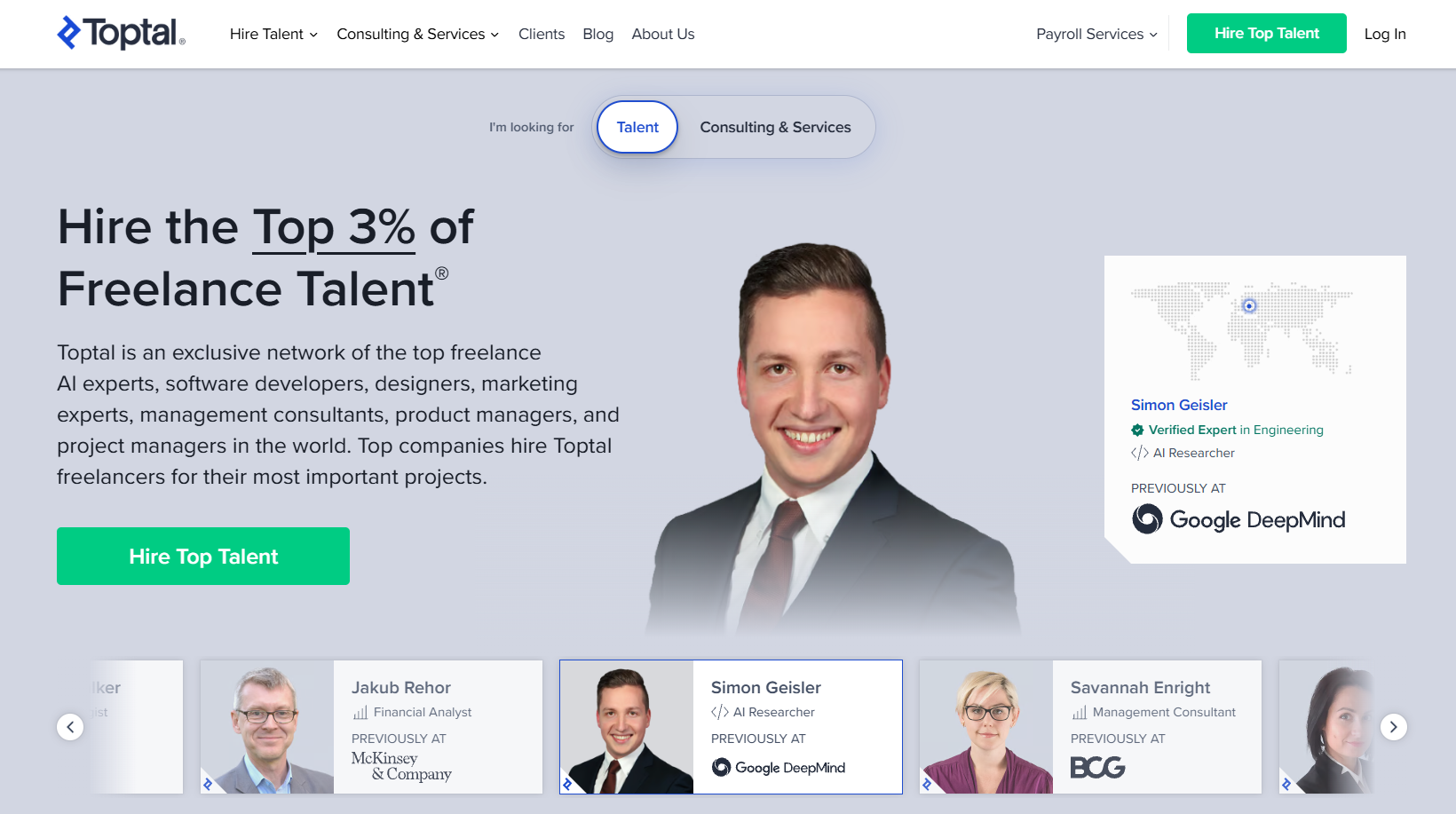 Toptal introduces you to a senior specialist, usually within 24 hours, picked by a talent matcher who works in the same field. That's the main change from Turing, whose AI-led platform alone performed the matching.
The matcher can move that fast because Toptal vets specialists when they apply. Each one passed a live screening with an expert in their field, who sets exercises on the spot, and then a test project lasting one to three weeks. By the time you meet someone, they've been judged on project work as well as tests. Fewer than 3% of applicants get in.
Each engagement opens with a trial you aren't billed for if the fit is wrong, and you can try up to three people for one position. Once someone starts, you direct their work on an hourly, part-time, or full-time schedule and can change it within weeks.
Toptal stops short of employing the specialist, though. They work as an independent contractor, and you handle classification and local compliance unless you add HireGlobal, a separate Toptal product for managing a workforce. Bringing the person in-house is possible on a case-by-case basis.
For a project that can't slip and needs a senior specialist this week, chosen by someone who knows the field, Toptal can fill the role. But it’s not the first choice when you’re hiring for a role you expect to keep for years, or if you need someone explicitly vetted against your opening rather than the industry standard.
What you get with Toptal
- Designers, product and project managers, marketers, consultants, and sales experts, matched the same way as developers
- A single specialist or a cross-functional team of ten, scoped from one job brief
- A full profile for each candidate, with years per skill, past projects, and availability
- Specialists in the time zone your team works in, anywhere in the world
- Credit for billed time if a specialist misses hours they were scheduled to work
Toptal pricing
Every specialist sets their own hourly rate, so what you pay depends on who you hire and on the schedule.
- Talent rate: Set by the specialist, billed on an hourly, part-time, or full-time schedule
- Platform subscription: $79 a month from the point you move into matching, until you cancel
- Direct-hire buyout: $50,000 within 30 days of hiring the specialist yourself, and a year of paying them through HireGlobal after that
Toptal rating
- G2: 4.7/5 — based on 270 reviews
3. Arc.dev: Best for trying a developer freelance before converting them to full-time
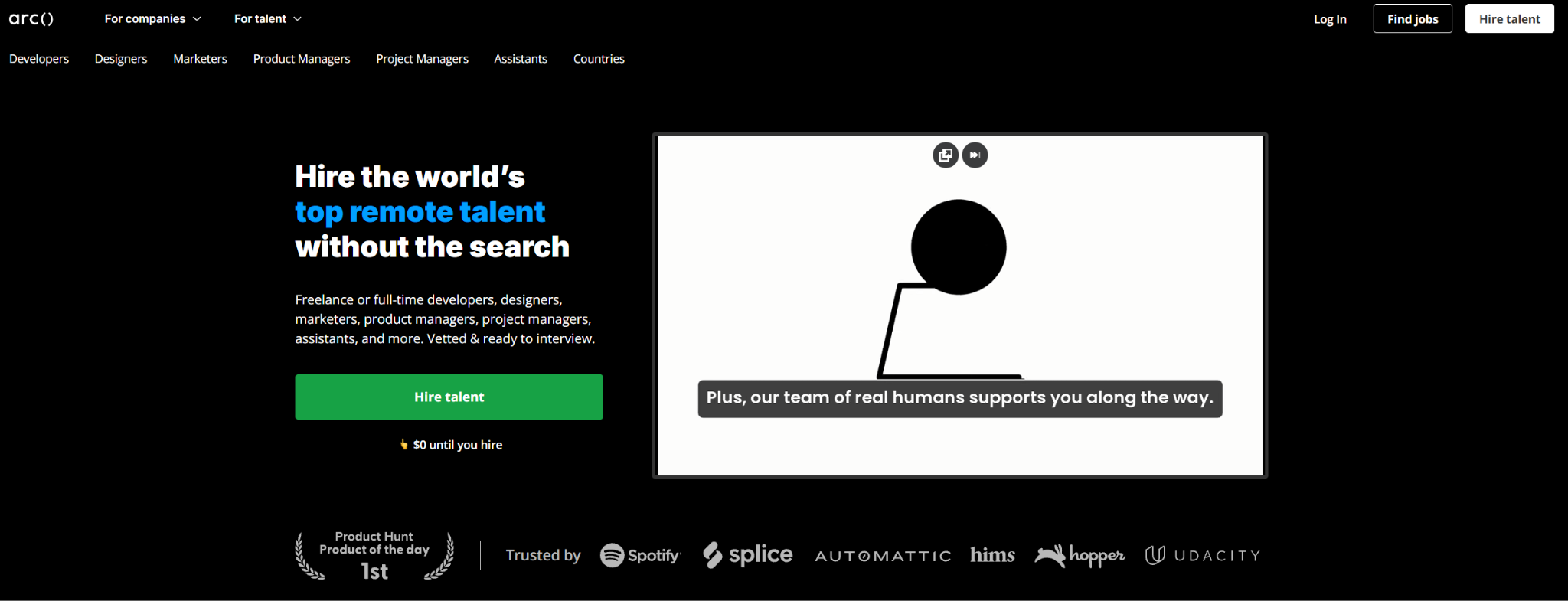 Arc.dev lets you start a developer as a freelancer, usually within 72 hours, and hire them later on terms stated before the work begins. The developer reports to whoever you name and works the schedule you set, while Arc pays them.
Arc's freelancer sourcing agreement sets those terms. You hold an option to hire anyone Arc introduced, during the engagement or after it ends, with written notice and a wind-down of about 30 days, and the buy-out is fixed in the same agreement. On Turing, you need the company's written agreement before hiring one of its engineers yourself.
A trial comes first, and if the developer isn't right, you aren't billed for it and Arc lines up someone else, up to three developers in all. After that, either side can end the engagement on three business days' notice.
Employment is the piece Arc leaves to you. Converting a developer puts them on your payroll, or with an employer of record such as Deel or Remote if you have no entity in their country. The pool also spans 190 countries, and overlap with your working day depends on what you ask for in the listing.
When you can't yet say whether an opening is a three-month push or a permanent role, Arc lets you start the work now with the terms of keeping the person already settled. If you expect to keep them from the start, the freelance stage adds a step before the hire.
What you get with Arc.dev
- A four-step vetting process ending in a one-hour technical interview
- Full-time placements from the same pool, averaging about 14 days, with a dedicated recruiter
- Another candidate at no charge if a full-time hire doesn't work out in the first three months
- Freelance hours billed against work reports you approve
- Designers, marketers, and product and project managers alongside developers
Arc.dev pricing
Arc charges nothing until you hire, and what you pay depends on the track. Freelance engagements open with a risk-free trial (up to two weeks).
- Freelance hires: Billed by the hour, with rates from $15 to over $110
- Full-time hires: 20% of the hire's first-year pay, as a one-time placement fee
- Freelance-to-permanent buyout: $20,000 or 20% of first-year pay, whichever is greater, due within 30 days of the hire
Arc.dev rating
- G2: 4.8/5 — based on 18 reviews
4. Revelo: Best for month-to-month engineering capacity on contracts you retain
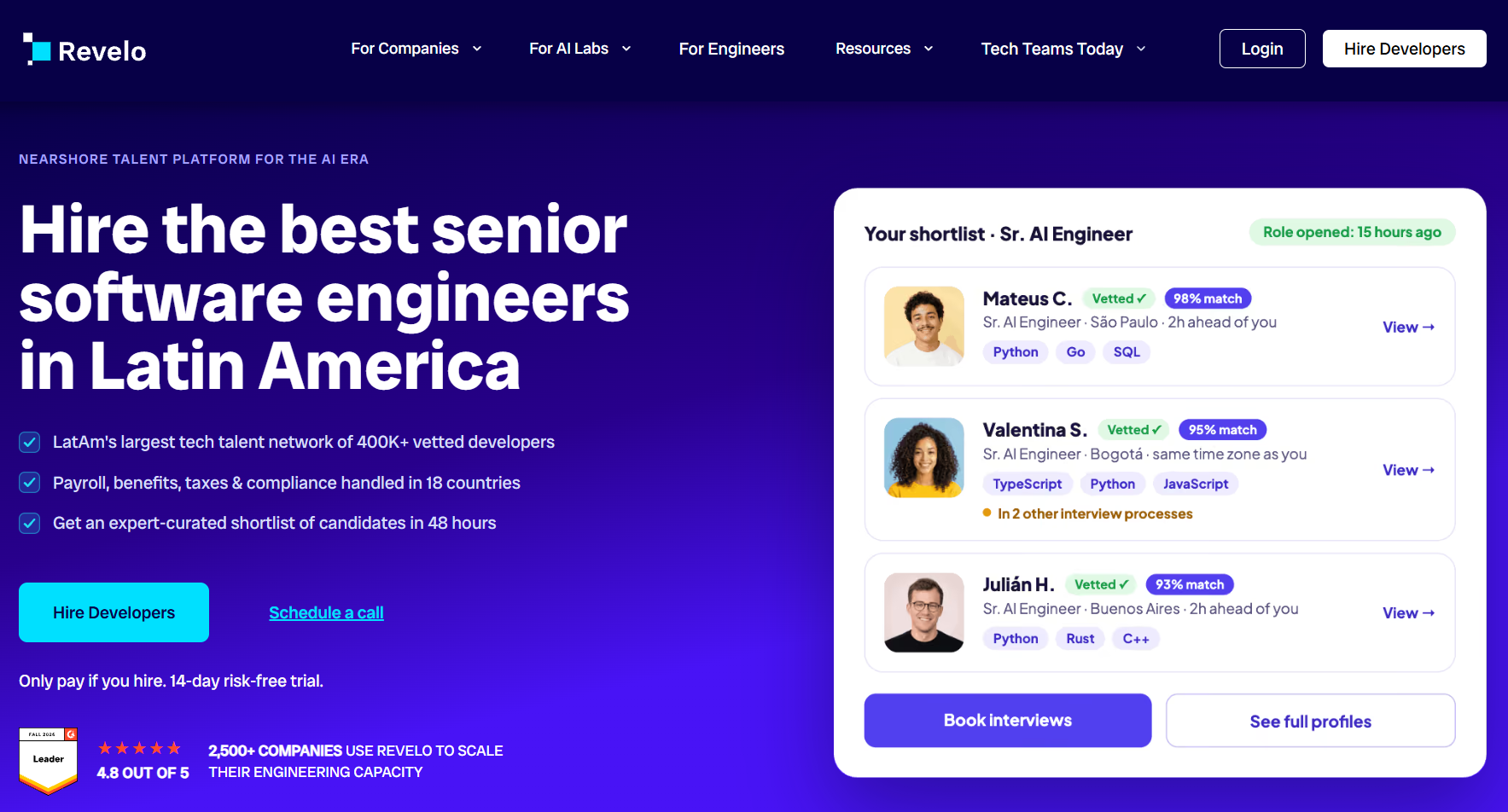 Revelo gives you a full-time engineer from Latin America on month-to-month terms. There's no long-term contract or cancellation penalty, so you can add or release engineers as your plans change without renegotiating terms.
Each contract is between your company and the engineer. Revelo signs it as your Agent of Record, on terms you approve, and administers it, from payments to local taxes, in the 18 Latin American countries it hires from. The engineer stays an independent contractor. Turing's engineers are contractors too, but you pay Turing for their work, where a Revelo contract is in your company's name.
Revelo's recruiters match three to five candidates to your role within 72 hours, from engineers who were screened when they joined the network. That screening happened before your role existed, and Revelo runs a deeper technical review against it only if you ask at the start.
Without that review, your team runs the technical interviews. Someone who knows your stack has to make time to test each candidate's depth, and that interview is the only technical check made against your role. Because each contract is in your company's name, the classification question is yours too, though Revelo's compliance indemnification covers part of it within your agreement's limits.
When you want full-time engineers you can add or release month to month, and your own engineers can run the technical interviews, Revelo is built for that. Hourly and part-time placements aren't its model, and it won't give you a hire classified as an employee.
What you get with Revelo
- Engineers working U.S. hours from Latin America, no more than two hours off Eastern time
- A network of 400,000-plus pre-vetted engineers across full-stack, back-end, DevOps, data, and AI/ML roles
- Candidate dossiers with recorded intro videos, for judging communication before an interview
- Quarterly retention check-ins after the engineer starts
- Ownership of everything the engineer builds, treated as work made for hire
Revelo pricing
Revelo charges one all-in monthly rate per engineer, with nothing to pay to start a search and no separate placement fee.
- All-in monthly rate: Covers the engineer's pay, benefits, payroll, and compliance, estimated per role through Revelo's calculator
- Security deposit: One month of the engineer's payment, refundable and applied to your last invoice
- 14-day trial: Nothing to pay for the trial period if the fit is wrong
- Direct-hire fee: Six months of invoices at first, dropping by one month every three months, with a $10,000 minimum
Revelo rating
- G2: 4.8/5 — based on 163 reviews
5. HireDevelopers by CloudDevs: Best for LATAM developers on rolling weekly contracts with no minimum
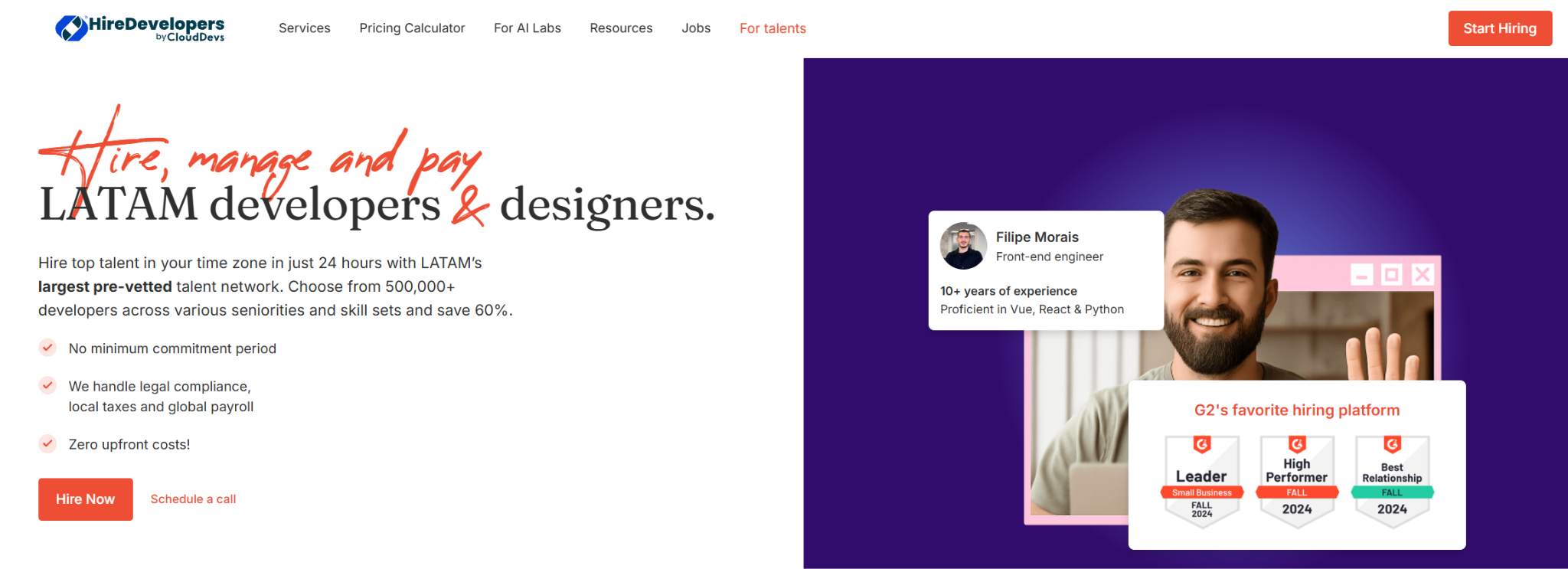 HireDevelopers (formerly CloudDevs) engagements roll week to week with no minimum term, so you can stop after any week. Turing's client terms ask for 30 days' written notice to end an engagement, however short the work turns out to be.
A shortlist of pre-vetted candidates reaches you within 24 to 48 hours of a first call, and you interview and choose before signing anything. The developers work from hubs in Brazil, Mexico, Argentina, and Colombia, within about two hours of U.S. time zones.
The first seven days, up to 40 hours, run as a trial. If the first match doesn't suit the work, you can take another with a fresh trial or end the engagement there. If the role turns permanent, you can move the developer to an annual contract or buy them out on terms you agree with HireDevelopers.
The developers stay independent contractors, engaged directly by your company, while HireDevelopers handles payroll and local labor-law compliance on the payments. You answer for how each developer is classified, which matters most when a week-to-week arrangement runs on for a year at full-time hours.
When the work is measured in weeks, such as a release crunch, HireDevelopers staffs it without asking you to commit past the current week. A role you already know is permanent gets little from the weekly terms.
What you get with HireDevelopers by CloudDevs
- A new developer at any point and for any reason, with a 24-to-48-hour target
- Developers ready to start as soon as you choose one
- Tech leads, CTOs, and engineering managers alongside developers
- Technical tests built to your requirements, arranged with candidates on request
- A monitored, plagiarism-checked live coding challenge at the end of entry vetting
HireDevelopers by CloudDevs pricing
CloudDevs' rates are hourly and all-in (vetting, legal compliance, and HR support included), billed each week for the hours worked, and searching and interviewing cost nothing.
- Standard rate: $45 to $75 an hour, no minimum commitment with vetting and HR support included
- Annual contract: $25 to $45 an hour in exchange for a year-long commitment
- Hiring deposit: $500 once you decide to hire, credited to your first invoice and refunded if you stop during the seven-day trial
- Healthcare plan: Optional, from $106 a month per developer
CloudDevs rating
- G2: 4.9/5 — based on 163 reviews
6. Upwork: Best for comparing freelancer bids and managing the hiring process yourself
 Upwork opens your job to a marketplace spanning 180 countries and more than 10,000 skills. Freelancers bid with proposals written against your requirements, and you compare them side by side, each backed by a verified identity, completed-project history, and client reviews. Most clients hire within three days of posting.
From that history, Upwork calculates a Job Success Score and awards badges. They run from Top Rated, for the top 10%, up to Expert-Vetted, for the top 1%, who also pass a screening with Upwork's own talent managers.
Turing does the screening before you meet anyone, where Upwork leaves it to you. If you ask, an AI-built shortlist of applicants arrives within six hours, but judging whether an engineer shipped what they describe still takes your own engineers' time. They read portfolios for production work and interview on a sample problem, and a shipped project close to your stack tells them more than any badge. You write the contract too, hourly or by milestone, and manage the work once it starts.
Upwork works best when you want to read the whole field yourself and decide who advances. A team without the hours to screen candidates properly won't get the most from it.
What you get with Upwork
- Employment through a third-party Employer of Record when a freelancer is best classified as an employee
- More than 290,000 pre-scoped projects, ordered as listed without posting a job
- Invitations you send to specific freelancers, instead of waiting for bids
- Payment held in escrow on milestone work until you approve it
- Contracts and payments for freelancers you found off the platform
Upwork pricing
Upwork is free to join on both plans and charges once you hire, as a percentage of what you pay the freelancer.
- Basic plan: 5% of freelancer payments (3% for eligible U.S. clients paying from a checking account), plus a one-time fee of $0.99 to $14.99 per new contract
- Business Plus plan: 10% of freelancer payments (8% by checking account), no per-contract fee except up to $4.99 on contracts under $100, and access to the Expert-Vetted filter
- Direct Contracts: $49 a month per active contract, for talent you bring from outside Upwork on Business Plus
- Any Hire: From $49 per professional per month plus 3% for contractor management, or from $199 plus 3% to employ someone through its EOR path, for talent sourced outside Upwork
- Conversion fee: $1,000 to $50,000 to move a freelancer you met on Upwork off the platform within two years of starting work together
Upwork rating
- G2: 4.5/5 — based on 3,227 reviews
- TrustRadius: 8.3/10 — based on 75 reviews
7. Andela: Best for enterprises combining external talent deployment with internal workforce upskilling
 Andela keeps your roadmap moving while your own engineers retrain on AI delivery. You're buying engineering capacity you can deploy now alongside a training program for the team you already have, from one vendor instead of two.
Blended Teams adds AI-native engineers to your own stack one at a time, assembled within 72 hours, and you direct them like anyone else on the team. With Managed Solutions, Andela assembles and runs a team against an initiative you hand over, such as training an LLM or orchestrating agents.
The training program is aimed at the engineers you already employ, covering LLM engineering, agentic systems, production deployment, and AI leadership, with each engineer benchmarked before guided projects and a capstone. Turing's developer service supplies a contractor from its global pool, where Andela adds a team it will run for you plus a curriculum for your own people.
Andela Pay AOR acts as agent of record for the engineers it deploys. It contracts with each engineer on your behalf and takes on the legal and classification risk in more than 100 countries, so you don't open a local entity to work with someone who lives in one.
An agent of record engages each person as an independent contractor, where an employer of record would employ them outright. For a role you plan to hold for years, that means renewing a contract rather than making a hire.
If your enterprise AI program is short on engineers now and on in-house skill for later, Andela covers both under one relationship. A company hiring one engineer for one project, with nobody to retrain, won't get the most value from it.
What you get with Andela
- AI engineers matched to the stage of your work, from building features to running models in production
- New cohorts of AI engineers every quarter, trained and assessed before they deploy
- Entry screening that ends in a live technical interview, with assessments built on real-world engineering scenarios
- Agent-of-record contracting and payment for contractors you source yourself, in more than 100 countries
- A remote talent network spanning more than 135 countries
Andela pricing
Andela prices each engagement by custom quote. What you pay follows the scope you agree on, including how many engineers you deploy and whether Andela assembles and runs the team or you manage the engineers yourself.
Andela rating
- G2: 4.7/5 — based on 1,536 reviews
- Trustpilot: 2/5 — based on 18 reviews
8. BairesDev: Best for handing a full software build to a team that owns delivery
 BairesDev builds and delivers the software for you. Your part is setting priorities, giving feedback, and signing off, and nobody on your team runs a search or a sprint board.
Discovery sets what the project has to deliver and by when, and a signed Service Level Agreement follows. The team then learns your requirements and existing systems in a knowledge transfer before development starts, and sprint reviews and working demos keep you current from there. The engineers work from Latin America on U.S. hours, so those reviews fall inside your working day. Handoff closes the project, and maintenance often continues past it.
A certified Scrum Master and Product Owner lead every team, running sprint planning, daily scrums, and retrospectives without your engineering leads. Turing's developer service would give you an individual engineer to direct. Here you direct nobody, and BairesDev answers for what ships.
The team itself isn't yours to pick. It's built around your industry and stack, and BairesDev decides which engineers join it and runs them on its own agile practices. You judge the work by its demos and deliverables rather than by interviewing the people building it.
BairesDev fits a project you want delivered without managing it yourself, like a legacy platform to modernize or a product line nobody in-house is free to build. The end-to-end model isn't built for filling a single open role on a team you already run.
What you get with BairesDev
- QA engineers, DevOps specialists, UX/UI designers, business analysts, and product owners alongside the developers
- Teams assembled in two to four weeks from a standing bench, with no recruiting on your side
- Team-level reporting on cycle time, throughput, and defect rates from a dedicated delivery manager
- Staff augmentation or a dedicated team from the same 4,000-plus engineers, for work you'd rather direct
- ISO 27001 certification, with projects delivered under HIPAA, SOC 2, FDA, and PCI DSS requirements
BairesDev pricing
Pricing is custom to the engagement and settled during discovery, which defines the scope, budget, and timeline together. What you pay turns on the size of the team and the roles on it.
BairesDev rating
- Clutch: 4.9/5 — based on 63 reviews
- Trustpilot: 4.1/5 — based on 177 reviews
9. Gun.io: Best for external talent with ongoing technical governance after deployment
 Gun.io keeps its own senior people on the engagement after your developer starts, checking what gets built against the plan you agreed at the outset. You direct that developer day to day, and Gun.io's reviewers keep reading the code and watching for architecture drift.
Gun.io audits continuously, tracking milestones and technical output against the standard set for the engagement. If your roadmap moves, Gun.io adjusts the mix of skills, and if the delivered work doesn't hit that standard, correcting it becomes Gun.io's responsibility, up to redeploying the team.
Gun.io's developers are contractors, as Turing's are, but Gun.io stays in the project after the match. You pick them from a shortlist that comes back three to five business days after you describe the skills you need. Each has passed an algorithmic screen, a background review, and a live technical interview with one of Gun.io's senior engineers, and about 100 of the roughly 1,000 developers who sign up each month get that far.
The platform is set up only for individual developers joining a team you already run. A group that already works together, or an agency brought on as a unit, has to be assembled from separate matches. Because the developers are spread across the Americas, Asia, and Europe, overlap with your working hours also depends on who you pick.
If the work matters more than the hire and nobody on your team has time to read a contractor's code closely, you'll get more from Gun.io. But with a staff engineer on your team already doing that review, you'd be paying for a second opinion you can produce in-house.
What you get with Gun.io
- Contracts, payments, and tax compliance handled across 100+ countries, including local IP and labor law
- A technology review, constraint mapping, and delivery risk identification before any developer is named
- Engineers deployed only with a verified record of delivery inside Gun.io's network
- Contract, contract-to-hire, and full-time engagements
- Intro calls arranged by Gun.io, with someone from its team sitting in
Gun.io pricing
You pay nothing until you start working with someone. Each engagement runs on a retainer set by your needs, the project, and what the developer expects to earn, with the full price shown on the developer's profile and Gun.io's fee inside it. Either retainer structure can be canceled at any time.
- Monthly retainer: Pre-booked monthly hours you can scale up or down as the work changes
- Accelerate package: A block of hours bought upfront for a discrete project (unused hours usable for 30 days after canceling)
- Full-time hire: 20% of the negotiated first-year base salary — ends the two-year non-solicitation clause and Gun.io's role in payments and agreements
Gun.io rating
- G2: 4.5/5 — based on 16 reviews
10. Near: Best for outsourcing part or all of your recruiting operation through RPO
 Near runs recruitment process outsourcing (RPO), taking on the sourcing and screening for every role you have open, so your team's hiring work starts at the final interview. A dedicated recruiter learns how your team hires and works inside that process, running a separate search for each position.
Where Turing's developer service gives you an engineer, Near takes on the recruiting behind each hire, from the searches and screening calls to the scheduling between rounds. It works alongside any recruiters you already have, taking the Latin American searches off their list.
Near's recruiters screen against the requirements you set at kickoff, including a live video interview for English, and first shortlists usually arrive within three to five business days. Kickoff to signed offer averages 21 days. The roles run from software engineering to finance, sales, and customer support, all sourced in Latin America, and many clients hire seven to 10 or more people at once.
Near's searches cover Latin America only, so any roles you need filled in the U.S. stay with your own recruiters. Every placement is also full-time, with no short engagement you can add and release as demand shifts. A three-month project would mean a permanent hire for temporary work, or a separate search outside Near.
Near is at its strongest with several roles open across functions and more searches than your team has hours to run. For a single hire now and then, most of what an RPO arrangement offers sits idle.
What you get with Near
- Executive search for director, VP, and C-suite roles from the same team
- Fresh sourcing on every search, on top of a 160,000-plus pre-vetted network
- A short video from each shortlisted candidate, for ruling someone out without a call
- Pay benchmarks for each role and level, with the final offer set by you
- No exclusivity, so searches through other agencies can run in parallel
Near pricing
Near doesn't publish its fees. There's no upfront cost and no minimum number of roles or hires, interviewing candidates is free, and you pay only when you hire, on one of two terms.
- Direct hire: A one-time placement fee, with the hire on your own payroll or an EOR you already use, and a new match if the hire doesn't work out within 180 days
- Staffing model: A monthly fee as a percentage of the hire's pay, with contracts, payroll, benefits, and compliance handled through Near's EOR partners and a new match for as long as the engagement runs
Near rating
What to evaluate in a Turing alternative
When you evaluate a Turing alternative, measure it against what Turing's developer service gives you: a pre-vetted contractor you manage yourself.
Each of the six points below is a place where a replacement can differ.
- Vetting methodology (AI vs. human). Find out who makes the final call, a model or a person, and whether candidates are assessed against your role or a general bar. The answer tells you how much of your own interviewing to plan for.
- Employment and contractor structure. Know who the legal employer is, or whether there is one. With an independent contractor, you handle classification and local compliance, while working with an Employer of Record takes away that responsibility.
- Delivery ownership. Decide whether you want to direct the work yourself or hand a vendor the desired outcome. An engineer you manage joins your sprints, while a managed team answers to the vendor's project lead.
- Time-zone overlap and talent geography. Count the working hours you'd share each day. A global pool widens the skills you can reach, and a regional one, such as hiring developers in Latin America, puts the engineer in your standups for at least four hours per day.
- What the engagement includes. Look at what the provider handles after the start date, from payroll and benefits to equipment and performance reviews. Two offers that look alike at the shortlist stage can leave your team with very different work afterward.
- Engagement terms and flexibility. Check the minimum commitment, the notice period, and the terms for hiring the person directly later. Those terms matter most when you aren't sure how long you'll need the role, or when you're converting an engineer you already work with.
If you're switching with engineers already in place, the last two points usually decide how smooth the move is.
How do Turing alternatives differ by hiring model?
Each platform above sells one of these seven models, and a few offer more than one. Turing's developer service most resembles the curated freelance network, with engineers engaged as contractors you manage.
For a side-by-side view, you can see how Strider compares with other remote hiring models.
|
Hiring model |
What you get |
Best fit |
|
Curated hiring with an Employer of Record |
A short list of candidates screened for your role, a full-time engineer you manage, and a partner that employs them and handles the contract, payroll, and compliance |
Roles you expect to keep for years, when you don't have a local entity or an international HR function |
|
Curated hiring with an agent of record |
Engineers matched to your role from a pre-screened network and engaged as independent contractors, with a partner that signs and administers each contract on your behalf |
Ongoing work you're comfortable keeping on a contractor arrangement, without opening a local entity |
|
Curated freelance network |
A pre-screened specialist matched to your brief within days and engaged as an independent contractor on hourly, part-time, or full-time terms |
A defined project or a skill gap with an end date |
|
Open freelance marketplace |
A large pool of freelancers who bid on your job post, with sourcing, screening, and management left to you |
Small or well-scoped jobs, and teams that want to run their own selection |
|
Contract-to-hire |
A freelance or contract engagement with set terms for bringing the person on directly later |
Roles where you want to see someone's work before you commit to a permanent hire |
|
Managed team outsourcing |
A team assembled and run by an outsourcing firm, with its own project management and responsibility for the deliverable |
Projects you want built without adding people to manage |
|
Recruitment process outsourcing (RPO) |
A recruiter who sources and screens candidates inside your own interview process, with the hire going on your payroll or an EOR you choose |
Several open roles at once, more than your own recruiters can run |
If two models both seem to fit, ask whether the role has an end date, because the answer usually separates them.
Why Strider is the best Turing alternative for long-term LATAM hiring
Turing's focus on frontier AI labs and enterprise agents suits the customers it now serves. If you came to Turing for developers of your own, you want that hire from a partner whose business is built around it.
Strider's business is that hire. It matches U.S. companies with engineers in Latin America who've been assessed against the role, then employs them and keeps supporting both sides for as long as the role lasts.
A year after the switch, the difference is in who the engineer is to you. With Strider, they're an employee with a contract, benefits, and equipment you never had to arrange, working inside your team during your day. When something comes up that has no obvious owner, a person at Strider works through it with you, which leaves you with the part you wanted: setting priorities and leading the work.
If that's the hire you're looking to make, book a call with a hiring expert.