

 Strider

Key OverviewAn Andela alternative doesn't have to be another Andela-style platform, and the right one depends on which part of Andela's model you want to change.
|
A developer can work with your team through Andela for years and still be engaged as a contractor. If you want your hiring partner to employ that person locally, you’ll need a different arrangement.
Andela connects companies with engineering talent worldwide. It also delivers AI projects and trains existing teams. That broader offering may suit your business, but the hiring arrangement still needs to fit the role you’re looking to fill.
The ten Andela alternatives below offer different ways to hire and support developers, from long-term nearshore employment to flexible contract work. We compare their hiring models and ongoing support, including who handles employment and how working hours line up with U.S. teams.
Top Andela alternatives compared
|
Product |
Who it's for |
Hiring model |
Talent focus |
Pricing |
|
Strider |
U.S. teams adding one or two engineers they plan to keep |
Curated hiring, employed through Strider |
Latin America |
One monthly rate per hire, nothing until you hire |
|
Toptal |
Teams scoping a defined project for one senior specialist |
Freelance specialist network |
Global |
Specialist's hourly rate plus a monthly subscription |
|
Revelo |
Teams whose engineering headcount changes month to month |
Contractors through an agent of record |
Latin America |
All-in monthly rate by seniority (about $4,600 to $10,700) |
|
BairesDev |
Companies that need a whole LATAM team in two to four weeks |
Staff augmentation, dedicated teams, or outsourced delivery |
Latin America |
Custom quote by team size, roles, and scope |
|
Arc.dev |
Teams deciding per hire between a contractor and an employee |
Freelance, contract-to-hire, or full-time |
Global |
Hourly for freelance, a share of first-year pay for full time |
|
Lemon.io |
Startups that need a senior developer within days |
Contract developers, with a direct-hire option |
Global |
Hourly ($60 to $90 typical), 160-hour minimum |
|
Gun.io |
Teams without spare senior engineers to review a contractor's work |
Contract developers with technical oversight |
Global |
Retainer set by the developer's rate, a fee for a full-time hire |
|
TECLA |
Companies hiring engineers and technology leaders at the same time |
Staff augmentation, direct hire, fractional, or interim |
Latin America, plus U.S. leadership searches |
Hourly averages by seniority ($28 to $58), 15% to 25% for direct hire |
|
Howdy |
Companies building a permanent LATAM team with support for each engineer |
Full-time employment through Howdy as EOR |
Latin America |
All-inclusive rate per hire, with Howdy's fee at 15% |
|
Upwork |
Teams with time to screen candidates themselves |
Open freelance marketplace |
Global |
A share of each freelancer payment (3% to 10%) |
1. Strider: Best for committed, fully supported LATAM engineers who stay for the long term
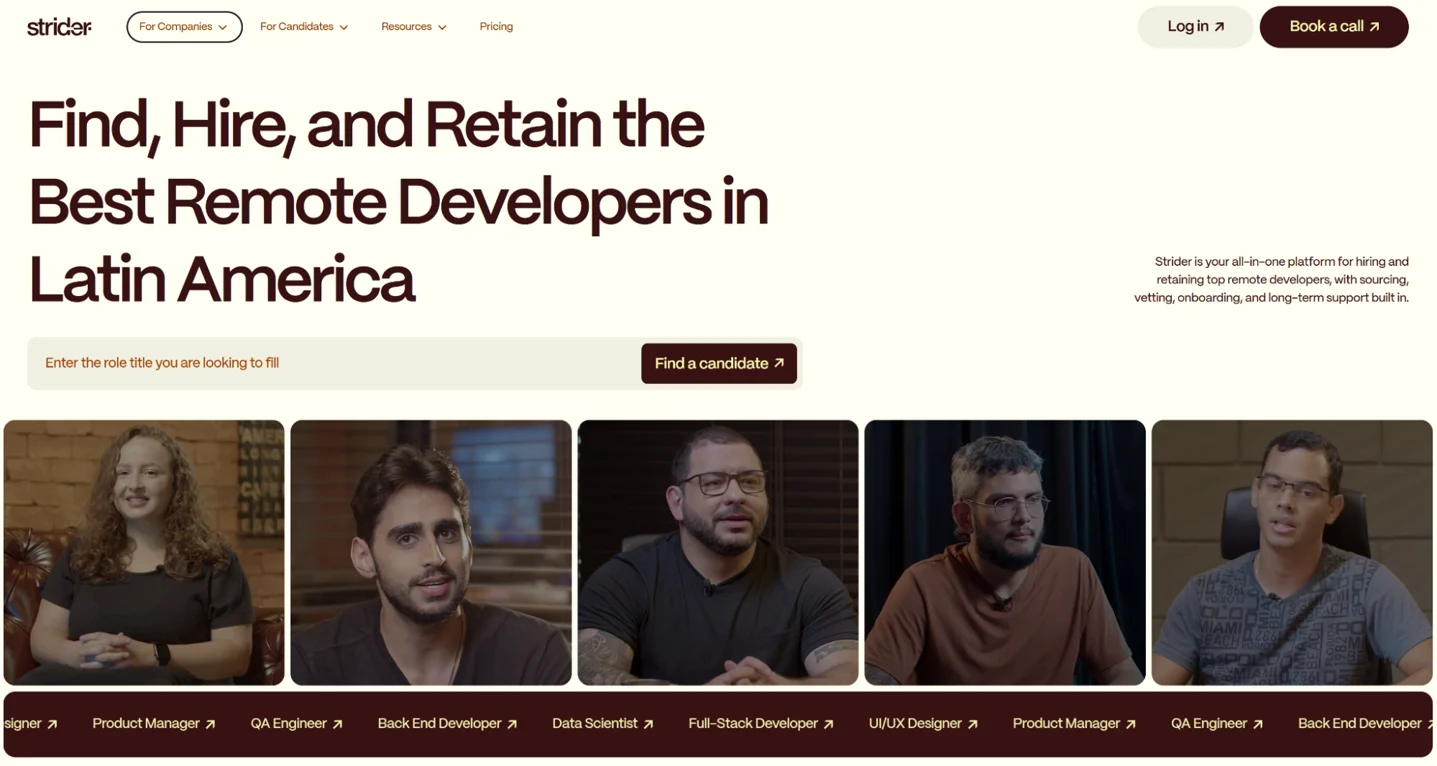
Strider combines talent matching in Latin America with local employment support for the engineers you hire. Full-time developers work exclusively with your company, on schedules sharing 4 to 8 hours with your U.S. teams, so they can become as much a part of your culture as your repo.
The employment arrangement is a key difference from Andela’s contractor-based model. Strider becomes the engineer’s Employer of Record (EOR), handling employment contracts, payroll, local taxes, and benefits, which means you can bring someone onto your team without setting up an entity in their country.
AI screening narrows Strider’s network to applicants whose experience fits your role, and recruiters then test their skills with questions written for the opening. Alongside that, professional English teachers grade recorded speaking responses on the CEFR scale. With those grades, you see each candidate’s level before the first interview, so you don’t spend that call finding out whether they can explain their work to your team.
Your initial candidate shortlist arrives within 48 hours of the first call. Selected candidates then meet a recruiter to discuss their motivation and fit for your team. Most clients make their first hire within 14 to 21 days.
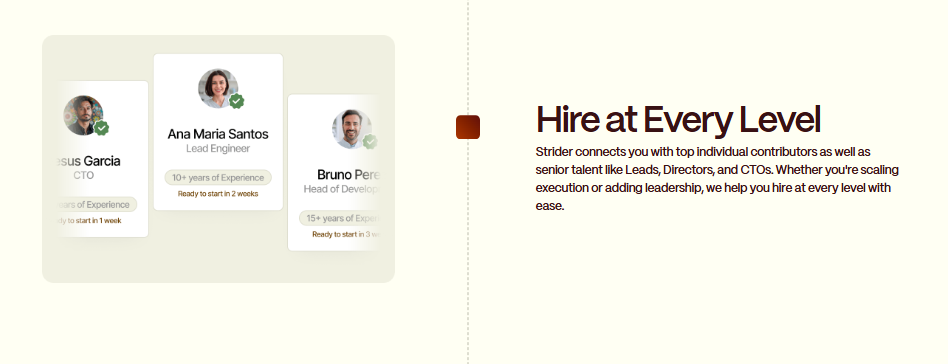
Before your final interview, a subject-matter expert assesses technical skills against the role. A live assessment explores a real project, including decisions about frameworks, databases, architecture, and security. Strider can also use a practical take-home task assessed to the same standard and tailored to your role.
From the first day, you have a dedicated account manager for the whole engagement, reachable over Slack or email. That's who you call when feedback needs careful wording or the engineer is flying in for your U.S. offsite. The customer success team behind them handles onboarding, hardware, and any other resources the hire needs to perform.
With Strider, you get developers matched to your role who work inside your team day to day. That means your team still sets engineering priorities and reviews the work, so it’s ideal if your team can manage delivery internally. If you want to hand over a brief and have a vendor run the project, this model leaves more responsibility with you.
What you get with Strider
- AI-ready talent: Find engineers for LLM and RAG projects, including candidates with MCP experience.
- 30-day fit window: If a hire isn’t a fit in the first 30 days, Strider finds a better fit at no extra fee.
- Roles across your team: Strider can also match you with DevOps, QA, data, product, and design hires.
- A path to full-time: An engineer can start part-time or on a set stretch of work, then move into a full-time role.
- Technical vetting report: The expert's write-up lists what to explore with each finalist in your final interview.
- 100+ technologies: Strider vets engineers across more than 100 technologies, from .NET and Go to React and Python.
Strider pricing
You pay nothing until you hire, and every hire comes with a 30-day guarantee. Each hire then has one fully loaded monthly price covering compliance, benefits, equipment, and HR administration. Strider's savings calculator estimates that price for your role.
- Role: The job you're filling, from engineering and data to design, product, or leadership
- Seniority: Four levels by years of experience, from junior (0 to 2) through mid-level (2 to 5) and senior (5 to 8) to staff or lead (8+)
- Engagement type: Long-term full-time, long-term part-time, or short-term full-time (estimated on a six-month basis)
What customers are saying about Strider
"We found one of our best engineers on Strider! The service is convenient and opens up an entire new market of talent we wouldn't have been able to tap without them." — Caleb Peffer, CEO and Co-founder, Mendable
"It wasn't a dev shop feel. These candidates were in it for a career-defining opportunity." — Keith Delaney, CEO and Co-founder, Primer
2. Toptal: Best for hiring vetted specialists for a project
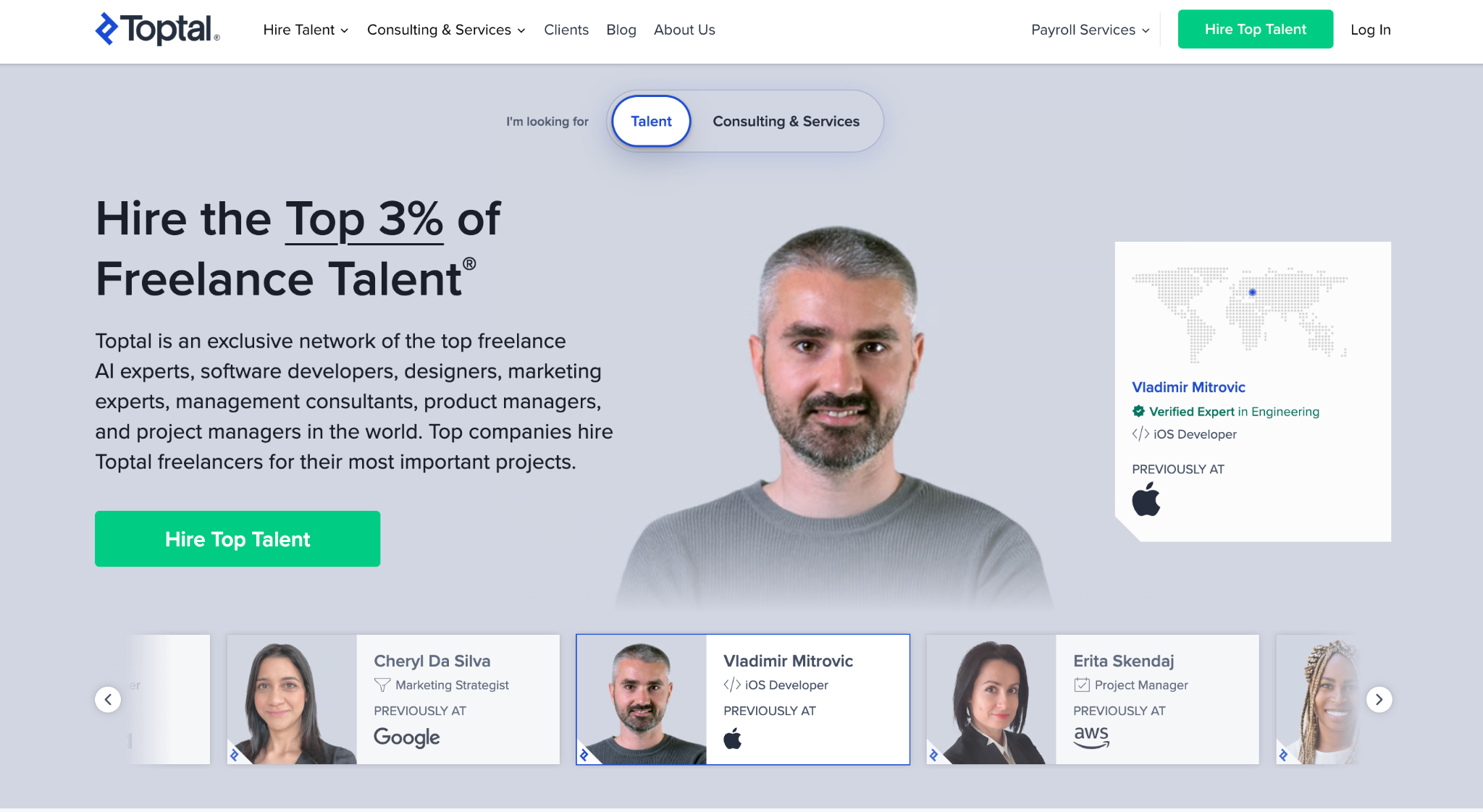
Toptal screens freelance specialists before introducing them to clients, ensuring every candidate you see is qualified from the start. For developers, the process begins with an English and communication interview, followed by technical assessments that include coding challenges and live problem-solving with experts in the same field. Applicants also complete a test project lasting one to three weeks, based on work they might encounter on a client engagement.
Matchers who work in your field choose whom to introduce from that network. The specialist you pick works under your direction, and the engagement opens with a trial of up to two weeks. If you’re satisfied, Toptal bills for that time and the engagement continues. Otherwise, you aren’t charged for the trial work and can request another match.
If no suitable specialist is available in Toptal’s network, it needs to find and screen someone new. That can add weeks to the search. For an uncommon skill set, it’s a good idea to confirm candidate availability before committing to a start date.
For a project you can manage internally, Toptal gives you a screened freelancer and a trial to ensure their fit before you continue. If you expect to bring that person in-house later, Toptal alternatives with more hiring flexibility from the start may work better.
What you get with Toptal
- Screening methods matched to each discipline, from coding challenges to portfolio reviews and business cases
- Trials with as many as three specialists for one position before you commit
- Profiles that show each specialist's years per skill, past work, and current availability
- Cross-functional teams assembled around your project
- A clickable time-zone map on skill hiring pages for finding specialists in a chosen zone
Toptal pricing
Your quote depends on the specialist’s location and seniority, along with the project scope and working hours. Here’s what you pay:
- Talent fees: Quoted for the specialist and agreed workload.
- Platform subscription: $79 a month once you proceed with talent matching.
Subscription cancellation requires no active engagement and at least three business days’ written notice before the next billing date. If Toptal can’t present any talent, you can request a refund of up to one month’s subscription fee.
Toptal rating
- G2: 4.7/5 — based on 270 reviews
3. Revelo: Best for adding LATAM developers as month-to-month contractors
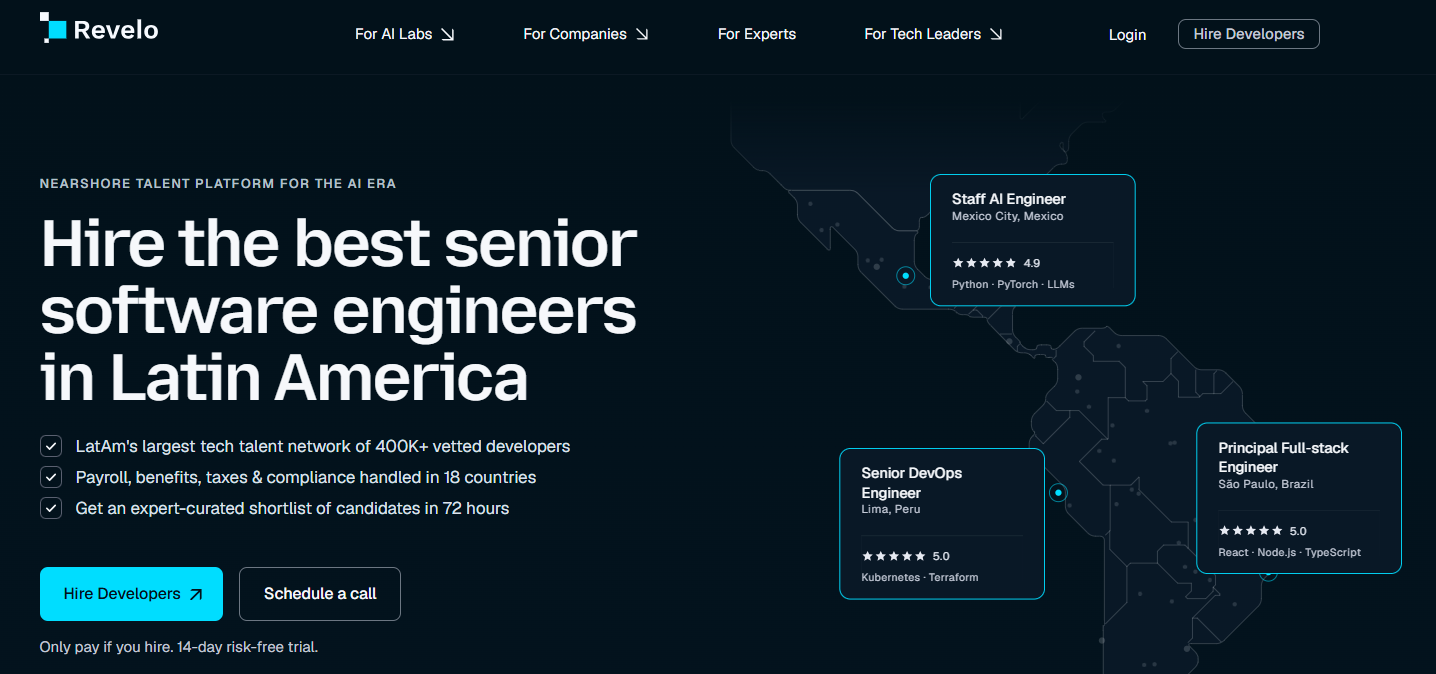
Revelo lets you add LATAM developers on month-to-month contracts as your workload grows. For example, you could bring in a mobile developer for an iOS app launch and only keep them through the first round of bug fixes.
Each one comes from a network of more than 400,000 developers in Latin America, each screened using written and spoken English assessments. For full-stack candidates, technical checks cover system design and how the front end connects with the back end. A practical challenge also assesses how candidates communicate while solving problems. After sharing your requirements, most clients receive a shortlist within 72 hours, then you run the last interviews before hiring.
Where Andela draws engineers from 135 countries and works out the overlap with each client before kickoff, Revelo hires only in Latin America. Its engineers work within two hours of U.S. Eastern time, letting them share most of your working day.
Revelo doesn't employ those engineers, though. Each one works for your company as an independent contractor, with Revelo acting as your agent of record in the 18 countries it hires from. If you want to move that person into an employee role outside Revelo’s arrangement, you’ll need to arrange their employment separately and pay their recruitment fee.
Revelo suits teams that want developers working alongside their existing staff without a long contract commitment. But its standard staffing model still uses contractors. So if you’re leaving Andela specifically to hire employees through a provider, compare the employment options offered by other Revelo alternatives.
What you get with Revelo
- A new engineer at no extra charge if the first hire isn't right within the 14-day trial
- Interview scheduling, pay benchmarking, offer negotiation, and contracts handled while you run the interviews
- Quarterly retention check-ins after hiring
- A web platform for contractor payroll, time off, and expenses, including contractors you already have
- Ownership of everything an engineer builds for you, with each deliverable treated as work made for hire
Revelo pricing
Each Revelo engineer is billed at a single all-in monthly rate, which includes their pay and benefits, payroll and compliance, and Revelo's margin. There's no charge to start a search or interview candidates, and the rate varies by role and seniority.
- Trial: The first 14 days of each hire, with nothing to pay for that period if the engineer isn't the right fit
- Deposit: One month of the engineer's payment, collected at the start, refundable, and credited against your final invoice
- Recruitment fee: Due if you hire a Revelo-introduced engineer directly, starting at six times the monthly invoice and falling by one month's invoice every three months (minimum $10,000)
Revelo rating
- G2: 4.8/5 — based on 161 reviews
4. BairesDev: Best for putting a LATAM engineering team in place within weeks

BairesDev gives you a choice between adding developers under your own leads and handing over day-to-day delivery management. It staffs these engagements from a workforce of more than 4,000 engineers across Latin America, all within a few hours of U.S. workdays, and a dedicated team can be ready in two or four weeks.
With staff augmentation, your leads assign the work and manage the developers, who join your standups and use tools such as Jira and GitHub. A dedicated team comes with a BairesDev project manager and Scrum Master to run sprints and coordinate work when a delay blocks the next task, such as testing held up by an unfinished feature. You set the team’s priorities.
For a fully outsourced project, BairesDev agrees on the scope and timeline during discovery, then signs a service level agreement and manages development through handoff. You review progress through sprint demos along the way. That delivery support covers projects such as building a mobile app or modernizing an existing platform.
The tradeoff is less direct control over daily assignments when BairesDev manages delivery. You still decide product priorities, but you coordinate changes with its project manager instead of assigning work directly to individual developers.
Consider BairesDev when you need to keep your internal team focused on an existing product while another team handles a rebuild. If you only need one developer, evaluate its staff augmentation service on that basis and compare it with other BairesDev alternatives.
What you get with BairesDev
- A delivery manager who monitors the quality and quantity of the work the team produces
- Pods drawn from engineers already on BairesDev’s staff
- Technical interviews with senior subject-matter experts, after online skills tests and an English exam
- Contracts with a U.S. company under U.S. law, starting from a mutual NDA and clear IP terms
- ISO 27001 certification, plus role-based access controls, enforced code reviews, and audit trails
BairesDev pricing
BairesDev provides custom quotes based on team size, required roles, technology stack, and project scope.
BairesDev rating
- Clutch: 4.9/5 — based on 63 reviews
5. Arc.dev: Best for deciding between engagement types for developers in one hiring workflow
Arc.dev helps you hire developers for freelance work or employee roles, with a dedicated recruiter supporting either route. Part-time engagements are also available, and its contract-to-hire option lets you start with freelance work before considering an employee role.
Every freelance engagement starts with a trial period. If the freelancer isn’t a fit, send Arc your reasons in writing within 72 hours of the trial’s end, and Arc won’t bill the trial and will offer another freelancer, up to three in total. Miss that window and the trial is billed as normal work.
A freelancer who works out can join your company directly through the conversion route in Arc’s agreement, for a buyout fee. You must notify Arc in writing and allow for a wind-down period, typically 30 days. You can also recruit for an employee role from the outset, which is the main difference from Andela, whose contractor-based model has no full-time employment option.
But you also decide whether each developer is legally a contractor or an employee, and you share the liability with the developer if that's wrong. Arc gives no guidance on that status, and it never becomes the employer. For full-time hires abroad, Arc works with employer-of-record partners such as Deel and Remote, adding another party to the engagement.
Arc can suit a role that starts with a defined project but may develop into ongoing employment. Before starting, confirm that the candidate is open to that move and decide whether your company or an EOR would employ them.
What you get with Arc.dev
- Entry screening of each developer's profile, English, and technical skill, which about 2% of applicants pass
- Another match, free of charge, if you're unhappy with a hire during the first three months
- AI screening that highlights top applicants and refines its matches after each profile you review
- Ownership of a freelancer's work product and IP once you've paid for it
- Integration with your applicant tracking system on full-time searches
Arc.dev pricing
There's no charge for searching on Arc until you hire. A freelance engagement starts with a trial period (up to two weeks).
- Freelance hires: $15 to $110+ per hour, the rate varies with role, experience, location, and requirements
- Permanent placements: A one-time, nonrefundable fee of 20% of first-year compensation. Part-time placements are calculated on the equivalent of a 40-hour workweek.
- Missing compensation documentation: Arc may set a $30,000 placement fee if it can’t obtain the signed offer or employment contract needed to calculate the fee.
- Freelancer-to-direct-hire buy-out: $20,000 or 20% of first-year guaranteed compensation, whichever is greater. This also applies to direct hires made within 12 months after the engagement ends
Arc.dev rating
- G2: 4.8/5 — based on 18 reviews
6. Lemon.io: Best for a small shortlist of senior contract developers within 24–48 hours
Lemon.io helps startups and smaller businesses find senior contract developers without running the initial sourcing and screening themselves. If you don't have an in-house technical lead, its team can help you clarify your requirements and assess the shortlisted developers.
Your request goes to a technical analyst, who narrows the vetted pool to developers whose stack and domain experience match yours and who are free to start. You get one to three of their profiles, each explaining in writing why that developer suits your project. Of those matches, 80% are delivered within 24 hours. Most developers in the network have six to eight years of commercial experience, and about 1 in 100 applicants gets through the screening to join.
You then meet the developers and can run your own technical interview or coding session before choosing one. On average, a developer starts one to two weeks after your request.
Like Andela, Lemon.io uses independent contractors for its standard engagements. You manage the developer’s work directly, while Lemon.io provides neither an employer-of-record arrangement nor employee benefits. If you want to hire the developer as an employee, its separate LemonHire service offers a paid trial before a direct hire.
When you need a senior developer for your startup soon and can't spare anyone to source and screen candidates, Lemon.io is a quick route to that person. It's less suited to a week or two of work, though, since engagements start at 160 hours.
What you get with Lemon.io
- Time-zone filtering during matching, and daily overlap hours agreed with the developer before the start
- Entry screening that ends with a senior engineer testing system design, live coding, and code review
- A new match at no charge, usually within 24 to 48 hours, if a developer goes quiet
- An optional trial of up to four weeks and 160 hours before committing to a direct hire
- Contracts, NDAs, and invoicing taken care of, with developer pay sent directly by the platform
Lemon.io pricing
Lemon.io bills all work by the hour through a prepaid subscription and doesn't take fixed-price projects. There are no upfront recruitment or setup fees, and the minimum is 160 hours.
- Hourly engagement: $60 to $90/hr is the typical range, depending on tech stack, seniority, and scope, at 40 hours a week for full-time or 20 for part-time
- Direct placement: $20,000 if you hire or contract with a developer directly, or pay one outside the platform
- LemonHire: The developer's hourly rate plus a $2,000 management fee covering a trial of up to four weeks and 160 hours. If you proceed with the hire, the $2,000 management fee counts toward the $20,000 placement fee, leaving $18,000.
LemonHire includes a conditional 60-day guarantee after the trial: a free replacement if the developer resigns or fails performance standards, or a placement-fee refund if no replacement is found within 30 days of your request.
Lemon.io rating
- G2: 4.7/5 — based on 59 reviews
7. Gun.io: Best for senior-engineer oversight of a contract developer's work after they start

Gun.io combines developer hiring with ongoing technical oversight. Its senior experts review the team’s work against your project plan, giving you outside support with engineering delivery.
That review starts before anyone is introduced, when Gun.io studies your technology and identifies the risks to delivery. Once the developer starts, those experts track milestones, audit the code's quality, and check the architecture for drift from the original plan.
When the work falls short of Gun.io's standard, Gun.io takes responsibility for fixing it, up to redeploying the team. Andela gives you a choice between engineers who join your team and a team it manages for you. Gun.io combines parts of both, pairing a contractor you direct with its own experts' review of the work.
Gun.io also offers direct salaried placements, so hiring an employee doesn't have to start with a contract engagement. If you want to convert an existing contractor, the developer must accept your offer and Gun.io must arrange a buyout of its non-solicitation restriction. Once you hire them directly, you take over the employment relationship, including payments and any disputes.
Gun.io is worth considering when you need engineering capacity and your technical leaders have limited time for ongoing review. Before starting, agree on how its reviewers will work with your own engineers and who has final approval over technical changes.
What you get with Gun.io
- A shortlist within three to five business days, with a staff member sitting in on each intro call
- Developer screening that combines an algorithm, a work history and background review, and a live senior engineer interview
- A change in the mix of skills on the engagement when your roadmap shifts
- A different developer brought in if the first match doesn't work out
- Payroll, contracts, and tax compliance across 100+ countries, with no geographic limits on payment
Gun.io pricing
Gun.io doesn't publish standard prices. Contract work runs on a flexible retainer scoped to your needs, the project, and the developer's pay expectations, and each developer's profile shows the full price with Gun.io's fee included. Nothing is charged before you start work with a developer. Both contract arrangements can be canceled at any time.
- Monthly retainer: A recurring share of the developer's time each month, scaled up or down as your needs change
- Accelerate package: A single block of hours bought in advance, with unused hours available for 30 days after you cancel
- Full-time hire: 20% of the first year's negotiated base pay, which applies to a direct full-time placement or a contractor you convert, and waives the two-year non-solicitation agreement
Gun.io rating
- G2: 4.5/5 — based on 16 reviews
8. TECLA: Best for combining staff augmentation, direct hire, and fractional technical talent through one partner
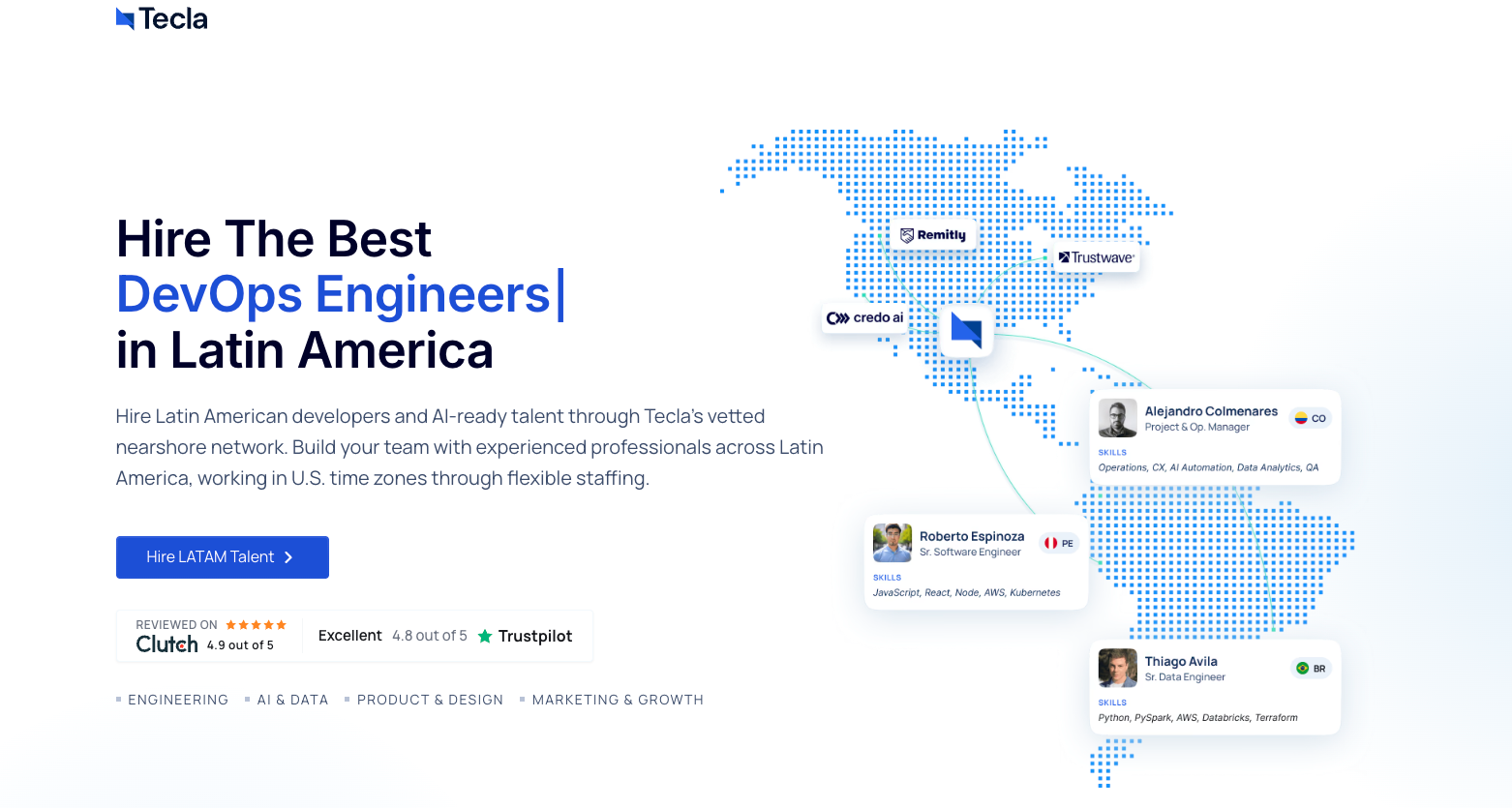
TECLA lets you build an engineering team and bring in a part-time technology leader through the same partner. You can choose a different hiring arrangement for each role, with nearshore talent drawn from 18+ Latin American countries.
Under staff augmentation, TECLA employs each engineer through its own EOR in their home country, and you direct the work. That differs from Andela’s contractor model. When you know a role is permanent, TECLA can fill it as a direct hire from the start, and an engineer who begins under staff augmentation can convert later.
TECLA can also recruit the leader who guides those engineers. A fractional CTO or CISO typically works 10 to 25 hours a week, for a role that doesn't yet justify a full-time hire. If you're filling a temporary leadership gap, an interim executive can work full time for three to six months. TECLA can recruit engineers alongside that leader and coordinate both engagements.
With a direct hire, TECLA stays involved only through the offer, acceptance, and onboarding. From then on, the relationship is entirely between you and the hire. The EOR employment and success support that come with staff augmentation don't carry over, so choosing direct hire for a role also makes you that person's employer.
TECLA is worth your attention when you're building an engineering team that also needs part-time leadership. The key decision is which people you want to employ directly and where you want TECLA to keep handling employment.
What you get with TECLA
- Engineers on full-time, part-time, or hourly terms, with no multi-year lock-in
- Executive searches for C-suite and VP technology roles across the U.S. and Latin America
- A dedicated account manager and a success manager on each leadership engagement
- Entry screening by AI, a recruiter, and a senior engineer, plus a check for hands-on AI work
- Data, product, design, QA, and marketing hires from the same LATAM network
TECLA pricing
You pay only once a hire or engagement begins. TECLA replaces unsuccessful placements at no extra cost within an agreed guarantee window, which varies by engagement model and seniority.
- Staff augmentation (engineering): $28 to $58 an hour, average all-inclusive rates by seniority, junior($28), mid-level ($48), and senior ($58), covering vetting, compliance, benefits management, equipment, and success support
- Direct hire: A one-time fee of 15%–25% of first-year base salary, confirmed before the search. Senior individual contributors fall in the 18%–20% range, while specialized and leadership roles are charged at 22%–25%
- Fractional, virtual, and interim leaders: A monthly retainer for fractional and virtual engagements, and a full-time-equivalent rate for interim ones
- Executive search: Billed only on placement, with no retainer and nothing upfront
TECLA rating
- Clutch: 4.9/5 (based on 23 reviews)
9. Howdy: Best for engineers supported by physical workspaces and performance coaches
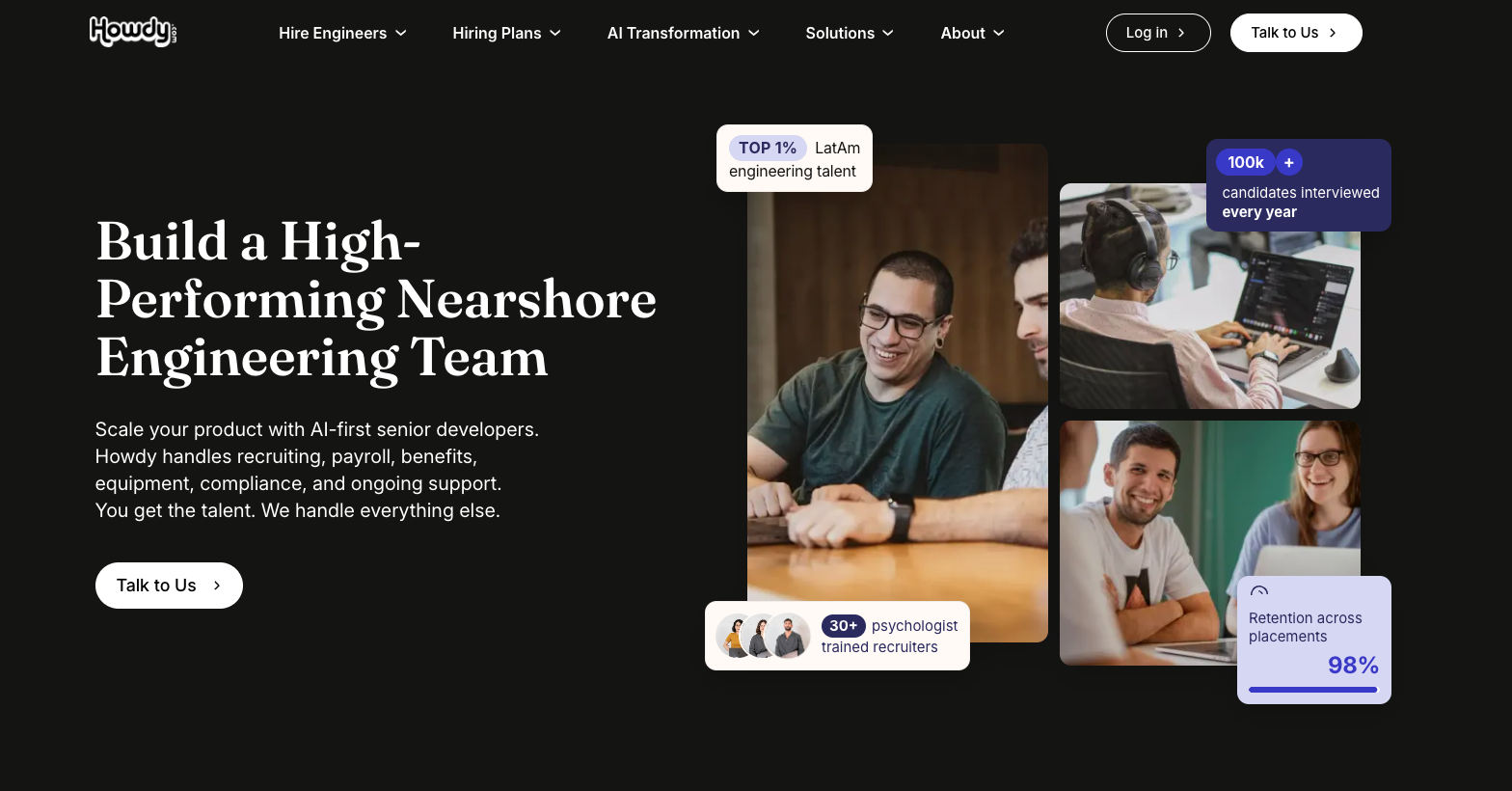
Howdy gives every LATAM engineer you hire a performance coach and access to a Howdy House, one of its offices in Latin American cities. It also handles payroll and benefits administration, with employer-of-record coverage available alongside contractor arrangements.
Each coach brings 10+ years of engineering management, and their goal is to help that engineer succeed at your company and provide ongoing mentoring. The level of support adjusts to your team’s needs, while your managers continue to direct the engineer’s work.
A House gives the same engineer somewhere to work beside other Howdy professionals. The Bogotá House, for example, has workstations and meeting rooms, and Howdy's community events include weekly lunches and workshops. Local HR and IT staff based there handle employment requirements and device setup.
Howdy places engineers in full-time roles without a preset end date. That makes it a better fit for an ongoing roadmap than a one-off project. You can still end the engagement under the agreed notice terms, though.
Howdy may be worth considering if your managers can lead the engineering work but need help giving remote hires consistent mentoring. Before hiring, agree on how the coach will work with your managers so that the engineer’s development stays connected to their role on your team.
What you get with Howdy
- Every device enrolled and configured to your security specifications before the engineer starts
- Recruiters who are trained psychologists, assessing motivation and long-term fit along with skills
- Vetted candidate profiles ready for review within 24 hours of first contact
- Contracts kept current by local compliance teams when an engineer's country changes its employment law
- English language programs and structured AI training for each placed engineer
Howdy pricing
Howdy bills each hire at one all-inclusive rate, with no startup, recruiting, or termination fees, and you pay nothing before your first hire starts work. Howdy's fee is 15% of that rate, and the other 85% goes to the engineer (on average 60% take-home pay and 25% benefits and local employment costs).
Howdy’s published agreement sets the following terms, which an executed statement of work can override:
- First month: You can end an engagement immediately by written notice during its first 30 days. If you end it within the first seven days, no fees are due.
- Notice after day 30: Generally, at least 14 days’ written notice to Howdy. The clock starts once the engineer is notified or you authorize Howdy to notify them.
- Larger teams: Above 10 Howdy professionals, the agreement requires four weeks’ notice or limits terminations to four professionals per week.
- Renewal: Fixed-term engagements renew monthly unless the statement of work says otherwise.
- Direct-hiring fee: 52 times the engineer’s weekly billed fee, unless Howdy waives or modifies it in writing.
- Non-solicitation: Direct hiring requires written consent during the agreement and for one year after it ends.
10. Upwork: Best for open bidding across a broad freelancer pool with self-managed vetting
Upwork lets you post a development job and compare proposals from freelancers. You can also search profiles and invite people whose experience fits the work. Its marketplace spans more than 18 million freelancers in 180 countries, so for nearshore hiring, use location and time-zone filters to focus your search on candidates in Latin America.
Upwork offers several ways to narrow that search. Business Plus and Enterprise clients can see the Expert-Vetted badge, which identifies freelancers in Upwork’s top 1% of their field. The evaluation includes a 30-minute interview assessing technical and interpersonal skills. On job posts where the feature is available, Upwork’s AI agent Uma can also collect video answers to your interview questions and provide ratings with summaries.
Once you’ve chosen a developer, you agree on the scope and payment terms through Upwork. Hourly contracts let you pay for time worked and set a weekly billing limit, which suits work that may change as it progresses. For a defined project, you can use a fixed-price contract with payments tied to agreed milestones.
The drawback of an open marketplace is volume. Badges and AI shortlists cut the reading down, but someone on your team who can judge code still reads the repositories and runs the interviews. Those hours come out of that engineer's own work, for every role you fill this way.
Upwork suits teams that want to choose a developer directly and negotiate the engagement around a specific workload. If you need ongoing support, confirm how many hours the freelancer can commit each week and when they’ll be available to work with your team.
What you get with Upwork
- Profile filters for location, talent time zone, English fluency, and job success
- Interviews by message, built-in audio or video call, or Zoom
- Identity checks by government ID and visual verification, plus a location check, before you connect
- Contracts you can update, pause, or end at any time as your needs change
- Escrow on fixed-price milestones until you approve the work, and weekly billing on logged hours
Upwork pricing
You can post a job on Upwork for free. When you hire, you pay the freelancer’s agreed rate plus Upwork’s client fees. Here’s a summary of what you can expect to pay:
- Basic: Up to 7.99% of each payment (3% for eligible U.S. clients paying by bank account), plus a one-time fee of $0.99 to $14.99 per new contract.
- Business Plus: 10% of each payment (8% for eligible U.S. clients paying by checking account), with Expert-Vetted talent and curated shortlists included.
- Moving off-platform: 13.5% of their hourly rate multiplied by 2,080 hours, falling to a small fee once the contract is more than two years old.
Upwork rating
- G2: 4.5/5 — based on 3,236 reviews
- TrustRadius: 8.3/10 — based on 75 reviews
Why teams look for Andela alternatives
Teams look for an Andela alternative when the role they’re filling needs a different arrangement from Andela’s, such as an engineer employed through a provider or a team based close to U.S. time zones.
These are the requirements that tend to lead teams to compare Andela with other providers:
- A contractor-only model: Andela engages engineers as independent contractors and doesn’t support a full-time employee model. Its contracts don’t include paid time off or employee benefits. If you want an engineer employed through your own entity or an employer of record, you’ll need a provider that supports that arrangement.
- A shift toward enterprise AI: When Andela launched its hiring platform in 2023, the pitch was a marketplace where you could hire individuals or teams. Its pages now lead with AI, from AI-native engineers to AI delivery and training, on one platform designed for enterprise AI transformation. If you're adding two engineers to a product team, much of today's offer is aimed at a bigger program than yours.
- A preference for a LATAM-focused provider: Andela can match candidates to location and time-zone requirements. You may still prefer a provider focused on Latin America if you’re building a team in specific countries. Compare platforms for hiring LATAM developers on their country coverage and local employment support, and confirm working-hour overlap with each candidate.
- Different vetting preferences: Andela assesses engineers when they join its network and conducts further vetting during matching. If you want a provider to complete a specific technical assessment before presenting candidates, compare exactly what’s included. Look at who evaluates the skills needed for your role and how much assessment remains with your team.
The next step is to decide what you want to handle internally and what you need a provider to take on. That distinction will help you narrow the list to the right hiring model.
What type of Andela alternative do you need?
The type of Andela alternative you need depends on who should employ or contract the engineer and who should direct their work. Where a provider offers several arrangements, judge it by the one you’d use.
The six main types compare like this:
|
Alternative type |
How it works |
Who manages the talent? |
Typical engagement |
|
Nearshore hiring platforms |
Engineers in Latin America are screened for your role, join your team on U.S. hours, and are often employed by the provider, which runs payroll and compliance |
You |
Months to years, usually full-time |
|
Curated talent networks |
Specialists screened when they join the network are matched to your brief within days and work as contractors |
You |
A project to a long-running contract, hourly to full-time |
|
Global AI-powered matching platforms |
Software matches your role against a large multi-country network, people review the matches, and engineers usually work as contractors |
You |
Engagements that renew, from months to years |
|
Freelance marketplaces |
You post the job, compare proposals, and screen and contract freelancers yourself |
You |
Set by each contract, from one-off projects to ongoing work |
|
Staff augmentation and managed development partners |
The provider's own engineers join your team, or the provider forms a team with its own project management and delivers the work |
You, or the provider's project manager |
A defined project to a multi-year engagement |
|
Multi-model hiring partners |
One provider offers several arrangements, such as contract, contract-to-hire, direct hire, or fractional leadership, chosen role by role |
You |
Varies by arrangement |
If two types both look right, start with how long the role will last. A role you'll fill for years usually belongs with a provider that employs the person or moves them onto your payroll. Work with a set end date fits a contractor model.
You can also see how the main remote hiring models compare before you build a shortlist.
How to choose an Andela alternative
Choosing an Andela alternative starts with the part of Andela’s model you want to change, since a provider that repeats it won’t solve the reason you’re leaving.
These six steps take you from that reason to a shortlist:
1. Decide what you want to change about Andela
Name the one or two things Andela doesn't do the way your hire needs. If it's the contractor arrangement, any option that also engages engineers as contractors is off the list, however strong its talent. If it's working hours, look at where each provider's engineers live before you look at anything else. Writing the reason down keeps you from shortlisting the same model under a different name.
2. Confirm the arrangement for your role
Ask who will employ or contract with the engineer and who will handle payments. Whether you choose an employee or a contractor, ask for a proposal that names who employs or contracts the engineer and who pays them, alongside what stays your responsibility. It should also distinguish engineers you’ll manage from a team whose delivery the provider will run.
3. Compare how talent is vetted
Ask when candidates are assessed and how the assessment relates to your role. Find out who evaluates technical ability and whether you receive their findings. For English, ask who grades proficiency and which scale they use.
If a provider offers both live interviews and take-home assignments, does it apply the same scoring criteria to both? Strider, for example, uses a live interview with a subject-matter expert or a take-home assessed against the same standard and rubric. The expert’s written on each shortlist arrives before your final interview, and it gives you evidence to assess a candidate’s skills and fit.
4. Check geography and working-hour overlap
Work out how many hours a day the engineer needs to be online with your team. A role built on standups, pairing, and same-day code review needs most of your working day, while work passed along in writing needs far fewer shared hours. Ask for the engineer's actual schedule, and check whether that overlap comes from where the engineer lives or gets agreed separately for each engagement.
5. Review the engagement terms
Look past the first month to the notice period, any minimum term, and how quickly you can add or release people. Find out what a provider does when a new hire isn't working, and whether bringing in someone else costs you anything. If you might hire the engineer directly, ask whether they can move into a longer-term or full-time role and confirm the conversion terms before work starts. Some contracts stop an engineer from working directly for you for a year or more after the engagement ends, which matters most once that person is central to your team.
6. Check what happens after the hire
Ask whether you’ll have a named contact after onboarding and what that person handles. Walk through how a pay discrepancy or performance concern would be resolved, including what your own managers would need to do. For employed hires, confirm who runs payroll and benefits administration. Also establish who supplies the laptop and arranges repairs if it fails.
Strider: Keep engineers on your hours, with their employment handled
Most of the providers on this list vet engineers before you meet them. Where they really differ is the engineer’s first day: who employs them, whose working hours they keep, and who you call when something needs sorting out. Andela’s answer is a contractor drawn from a 135-country network, which fits a large AI program spread across regions.
If you’re adding one or two engineers you plan to keep, you need different answers. Strider employs each engineer in their own country and hires in Latin America, so their working day runs alongside yours. One account manager stays on your side for as long as the engineer does, and your team keeps deciding what they build.
Bring the role and the hours you need covered to a call with a Strider hiring expert, and you’ll have a shortlist of vetted candidates within two days. Starting a search is free, and you pay nothing until you hire.