

 Strider

AI engineering has become one of the fastest-growing roles in the U.S., but hiring for it isn't as simple as searching for someone with the right tools on their resume. Two candidates can both list RAG, PyTorch, and machine learning experience while having worked on very different kinds of systems.
For example, one might have spent years keeping an AI product running in production. The other could have built prototypes without dealing with the traffic or changing data that comes with a live system.
To tell them apart, you need to know what each one has built and how they made the technical decisions along the way. The eleven AI engineering hiring sites below range from finding that out for you, while others leave the questions to your own engineers.
Best sites to hire AI engineers at a glance
|
Product |
Who it's for |
Engagement model |
Screening approach |
Pricing |
|
Strider |
Teams making AI a standing part of the product roadmap |
Short- or long-term full-time, or long-term part-time, employed by Strider as EOR |
Role screening, graded English, and a recruiter interview, with an expert technical review before your final interview |
Free until you hire, then a fully loaded monthly cost per role |
|
Toptal |
Teams that own the product and need one AI specialty covered |
Contract, hourly or 20 to 40 hours a week |
Communication and skill review, live exercises, and a test project |
Monthly platform subscription plus the specialist's hourly rate |
|
Arc.dev |
Teams unsure whether an AI role should be a contract or a permanent hire |
Freelance, full-time, or contract-to-hire |
Skills review, communication check, and an expert interview or pair-programming session |
Engineer's hourly rate ($15 to $110+), or a placement fee on full-time hires |
|
Upwork |
Teams with an engineer who can judge AI work and run the screening |
Freelance, hourly or fixed-price |
Identity verification, with technical vetting left to you |
Service fee on each payment, plus a fee per new contract |
|
BairesDev |
Companies without the in-house team to run an AI initiative |
Added engineers, managed pods, or full outsourced delivery |
Scenario exercises and a senior-engineer interview, with most hires placed directly |
Custom quote by scope, team size, stack, and roles |
|
Lemon.io |
Teams with the AI work already scoped and a sprint about to start |
Independent contractor, full-time or part-time |
Multi-stage vetting ending in a live interview with a senior engineer |
Hourly by stack and seniority (typically $60 to $90) |
|
Andela |
Companies that expect to keep adding AI engineers to the same initiatives |
Engineers added to your team, or a team Andela runs |
English test, technical assessment, and a live technical interview |
Custom quote |
|
Gun.io |
Teams adding senior contractors to a build where missing the plan is costly |
Contract, contract-to-hire, or full-time placement |
Algorithmic assessment, background review, and a live interview with a senior engineer |
Developer's hourly rate on retainer or prepaid hours, plus a fee on full-time hires |
|
Braintrust |
Teams with more AI roles to fill than time to screen applicants |
Contract, contract-to-hire, or embedded project squads |
AI interviews and async AI video screening, with certified profiles ranked higher |
Platform fee on each payment, plus a fee to convert or hire directly |
|
Proxify |
Teams that need senior AI work started now, before deciding what the role becomes |
Independent contractor, minimum 40 hours a month |
Timed coding assessment, English check, and a live technical interview |
Monthly rate by skills, seniority, and hours ($5,600 to $8,800 full-time) |
|
Fiverr Pro |
Teams that need a chatbot, automation, or prototype built without opening a role |
One order, fixed-price or hourly |
Portfolio, work-history, and ratings review before Pro acceptance |
Service fee per order, plus free or monthly Pro plans |
1. Strider - Best for long-term LATAM AI engineers who build and maintain production systems
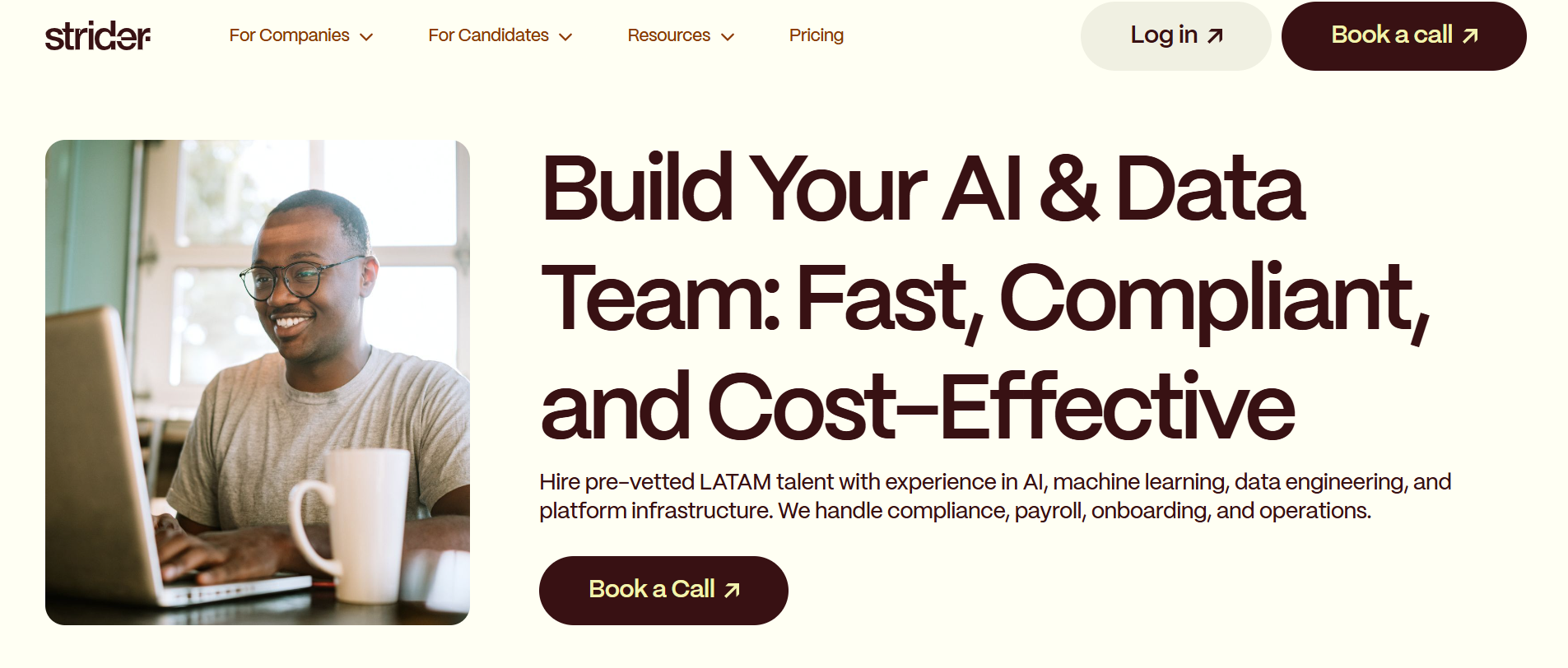
Strider matches you with a vetted, AI-fluent engineer in Latin America whose working day overlaps yours by four to eight hours. That overlap lets them join your standups and code reviews, and when something breaks in production, they're online to work through it with your team the same day.
Candidates come from Strider’s network of more than 150,000 LATAM professionals, all with their spoken English graded on the CEFR scale and eligible to work with U.S. companies. For AI work, you can hire machine learning engineers who train models and test how well they perform, and data and infrastructure engineers building the pipelines that supply the data those models learn from and run on.
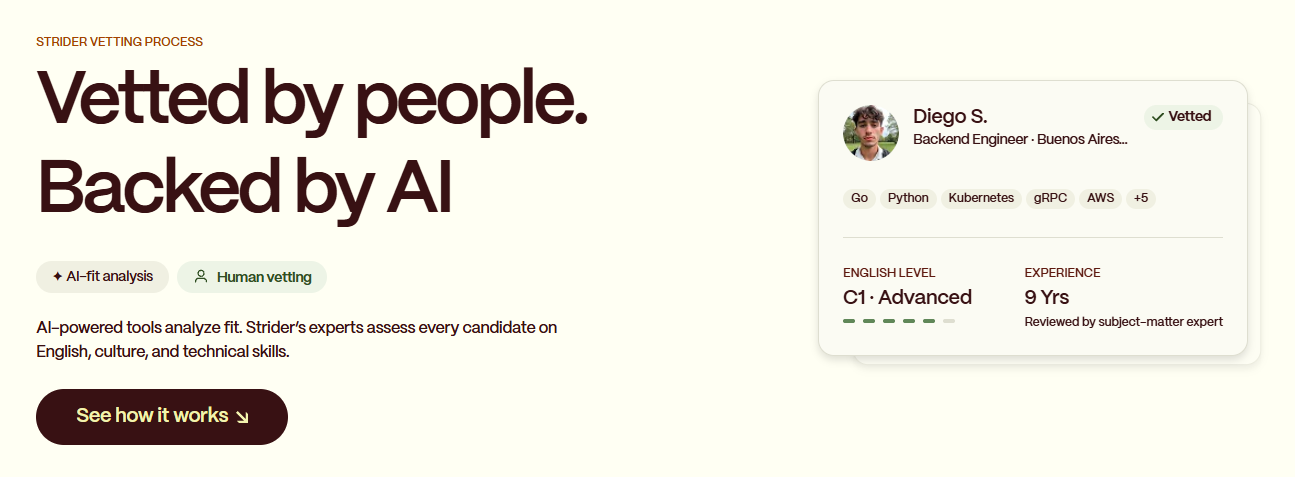
The process starts with an intro call, where you cover seniority, the stack, the AI work involved, and how much the engineer will work with product or leadership. Strider's AI screening narrows the network to candidates who match, and recruiters then check each one's stack and skills with questions written for that role.
Those who pass then meet a recruiter live to talk through their motivation, culture fit, and pay expectations. The recruiter also coaches them on which projects to lead with for your role and what your team is likely to ask, so they arrive ready to go deeper on that work in your interviews.
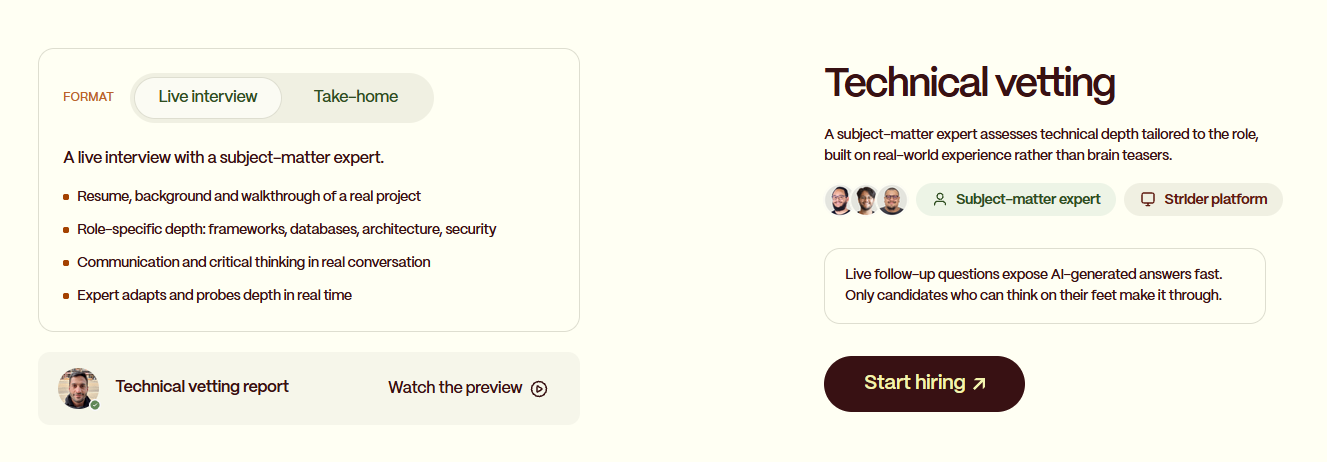
Within two days of the intro call, you get a shortlist of four or five candidates. Before your final interviews, a senior engineer takes each one through a project they shipped, asking why they chose its architecture, what trade-offs they made, and which parts they built themselves. For an AI role, that includes how they tested whether the model's output was good enough to release and what they monitored or fixed once real users relied on it.
The reviewer documents the findings in a written report, including what to cover in your final interview, such as a skill the role needs that the candidate's project didn't show. Most hires start on your roadmap about two weeks after the intro call.
The process concludes approximately two weeks after the intro call and the selected applicant starts working on your roadmap. Full-time hires work exclusively for your company, building familiarity with your codebase and taking responsibility for the systems they maintain as your product develops.
Throughout the engagement, Strider acts as the Employer of Record (EOR). It handles the contract, payroll, local taxes, benefits, and equipment, and takes on the compliance risk of employing someone abroad, so you don't need a local entity. Meanwhile, your engineering managers retain control of the work, from assigning tasks and reviewing code to setting technical priorities and deciding how the AI systems develop.
Strider is built for AI work that continues after the initial build. Full-time hires work only for your company, so when a model or feature reaches production, the engineer who built it stays to maintain it and build the changes that follow. For a one-off prototype with a fixed end date, a project-based engagement may be a better fit.
What you get with Strider
- 100+ technologies: Searches for AI developers run across more than 100 technologies, including Python, React, Node.js, .NET, Go, and TypeScript.
- Machine learning and data roles: Data engineers, analysts, and BI developers can support the pipelines, reporting, and infrastructure behind your AI work.
- Multiple hiring models: You can hire a dedicated engineer full-time, for a shorter stretch, or part-time on an ongoing basis.
- Account management and HR support: A named account manager works closely with you on your talent, and Strider’s HR team supports a successful partnership, your hire’s professional development, and anything else that comes up.
- Roles beyond engineering: The same network covers product managers, UX designers, analytics experts, and operations specialists.
- 30-day fit window: If a match isn't right within the first 30 days, Strider works with you to find a better fit for your team.
Strider Pricing
Free to get started and free until you hire. No upfront fees, no commitment, and you pay only once someone signs. Estimate your costs using the savings calculator.
- Fully loaded monthly cost: Compliance, benefits, equipment, and management bundled into one per-role monthly total, based on the hire’s role, seniority, and engagement type.
What customers are saying about Strider
"Top of the funnel was where Strider really brought value. The candidates we received were much higher quality than what we would get on the open market." — Mikhail Opletayev, CTPO, PetDesk
"Strider helped us avoid the typical hiring headaches and delivered candidates that actually made a difference in our team. Our 100% retention rate speaks for itself — the people we hired through Strider are still with us and performing at a high level." — Kyle Gashler, Engineering Manager, Zamp
2. Toptal - Best for hiring a specialist in one AI field for a defined part of your project
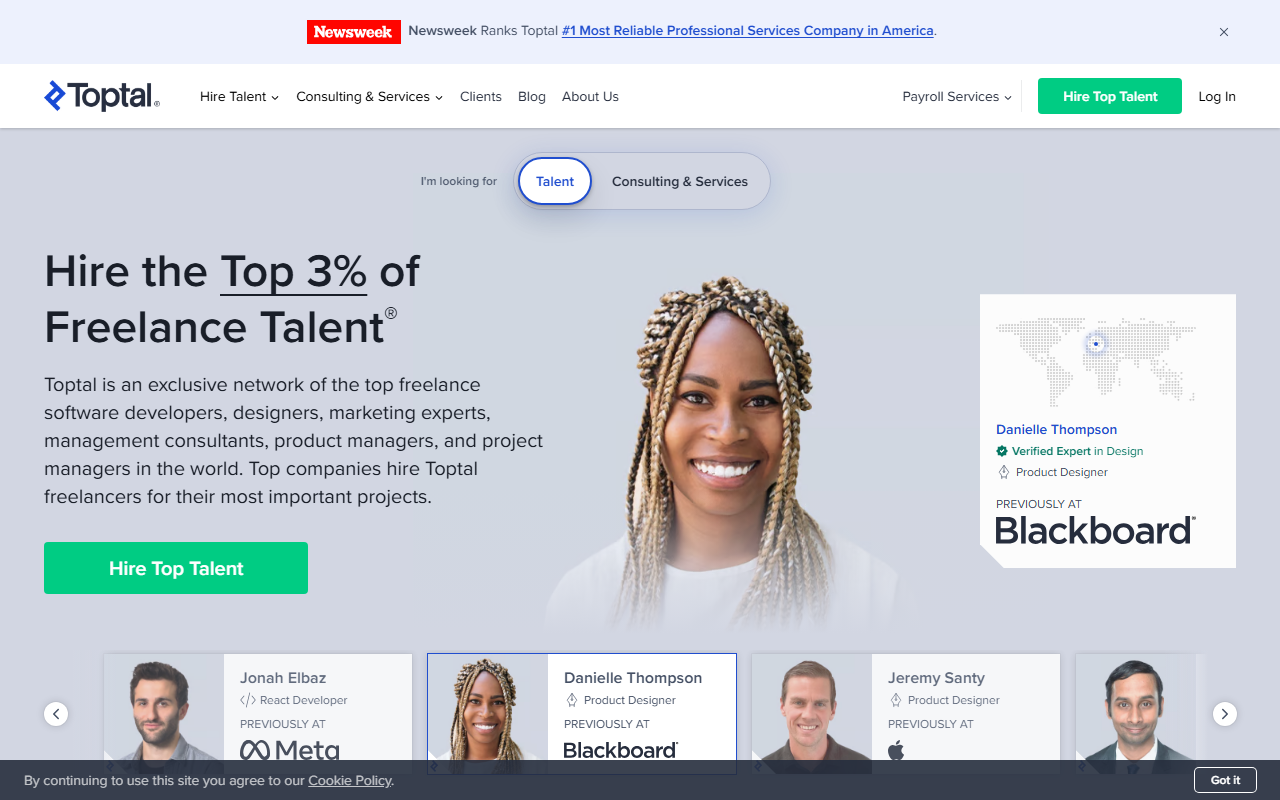
Toptal connects you with freelance AI and machine learning specialists who work remotely from more than 100 countries, mostly in the Americas and Europe. You can bring one in hourly, part-time at 20 hours a week, or full-time at 40, depending on how much of the project they'll cover.
Specialists are screened before they join the network. The process starts with an English and communication interview, followed by assessments of technical knowledge and problem-solving. Candidates who advance work through live exercises set by a screener from their own field, then complete a test project of one to three weeks built on a real-world scenario. By the time you're introduced, they've already delivered a full project under review.
Once you share the skills and seniority you need, a matcher who works in that field finds candidates for the role. Matchers aren't recruiters, so you can describe the work in the same technical terms you'd use with your own engineers.
Most hires happen within about 48 hours, but if nobody in the network fits, Toptal sources and screens someone new for the role within a few weeks.
Because Toptal hires are freelancers, your company is responsible for making sure each arrangement meets local rules for contractors, unless you add HireGlobal, Toptal's separate workforce management product. And if you want to hire them directly, you have to negotiate with TopTal first, rather than adding them directly to your payroll.
Toptal fits companies that need senior AI expertise for a defined part of a project while their own engineers run the wider product. Its screening and same-field matching let you bring in that specialist without building the expertise in-house.
If you need someone to stay on your team long term, or want candidates assessed against your specific role, look for long-term employment with role-specific vetting.
What you get with Toptal
- Generative AI, deep learning, neural network, and recommendation-system specialists in one AI developer pool
- Public expert profiles with skill tags, years of experience per skill, and past engagements
- Trials with up to three professionals per position before you settle on one
- Ownership of the work an expert creates for you, with IP passed through under the talent agreement
- End-to-end AI project delivery by a consulting team, from discovery through deployment
Toptal Pricing
Toptal pairs a flat platform subscription with talent rates that aren't published anywhere on the site.
- Platform subscription: $79/month flat fee — charged once you move into talent matching
- Talent rates: Contact for pricing — talent set their own hourly rates, with invoices roughly twice a month on Net 10 terms
Toptal rating
- G2: 4.7/5 — based on 270 reviews
- Trustpilot: 4.8/5 — based on 2,536 reviews
3. Arc.dev - Best for trialing an AI freelancer before hiring them full-time
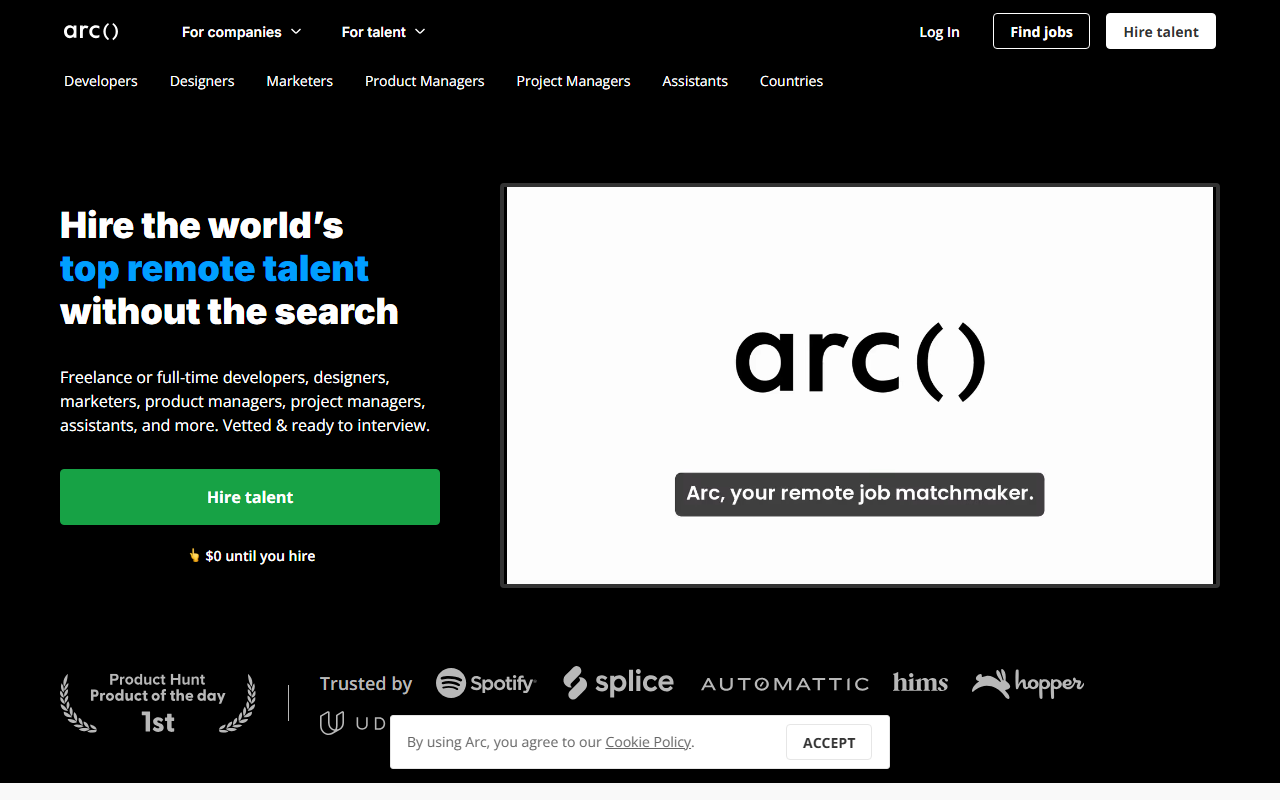
Arc.dev lets you try an AI engineer on real work before deciding whether the role should be permanent. Freelance and full-time hires come from the same vetted network across 190 countries, so an engineer who works out on a freelance contract can move into the full-time role without a new search.
Every engineer passes three checks before joining. Arc first reviews their skills, training, and industry experience, so applicants without a relevant track record don't reach the interviews. A live interview or recorded video introduction then tests their English and how they communicate remotely, and the last step is a one-hour interview or pair-programming session with an expert in their field, who tests domain knowledge and problem-solving.
HireAI, Arc's GPT-4-powered matching tool, pulls candidates from the network for your role, and you choose who to interview. Each profile shows the engineer's country and UTC offset, so you can see how many working hours you'd share before the first call. Arc's full-time plans also include an integration with applicant tracking systems such as Greenhouse, so candidates for permanent roles land in the system you already use, alongside your other applicants.
Converting a freelancer, though, takes about a month. You give Arc written notice and a 30-day wind-down period, which lets the engineer finish commitments to Arc's other clients before joining your payroll. If you already know the role is permanent, hiring full-time from the start saves that month.
Arc suits companies that already run their own hiring process and want vetted candidates for contract and full-time AI roles in one place. You choose who to interview, permanent candidates move through your existing applicant tracking system, and your engineers make the final call on technical fit. Without engineers who have time for those interviews, a provider that handles more of the technical assessment is the easier route.
What you get with Arc.dev
- Profiles tagged by AI specialty and tooling, from PyTorch and LLMs to computer vision and NLP
- Job posts that state the minimum daily overlap hours you require with your team
- Contracts, compliance, and payroll for cross-border hires through Deel and Remote
- Another match at no charge if you're dissatisfied during the first three months after a hire
- An account manager and recruiters working with you through each hire
Arc.dev Pricing
Arc charges nothing until you hire, then bills by engagement type.
- Free job posting: $0 — reaches Arc's network, without access to pre-vetted candidates
- Freelance hires: $15 to $110+ per hour — at the engineer's own rate
- Full-time hires: 20% of the annual pay— a one-time fee
- Contract-to-hire conversion: Custom quote — a negotiated fee applies
Arc.dev Rating
- G2: 4.8/5 — based on 18 reviews
4. Upwork - Best for hiring AI freelancers through open bidding and self-managed vetting
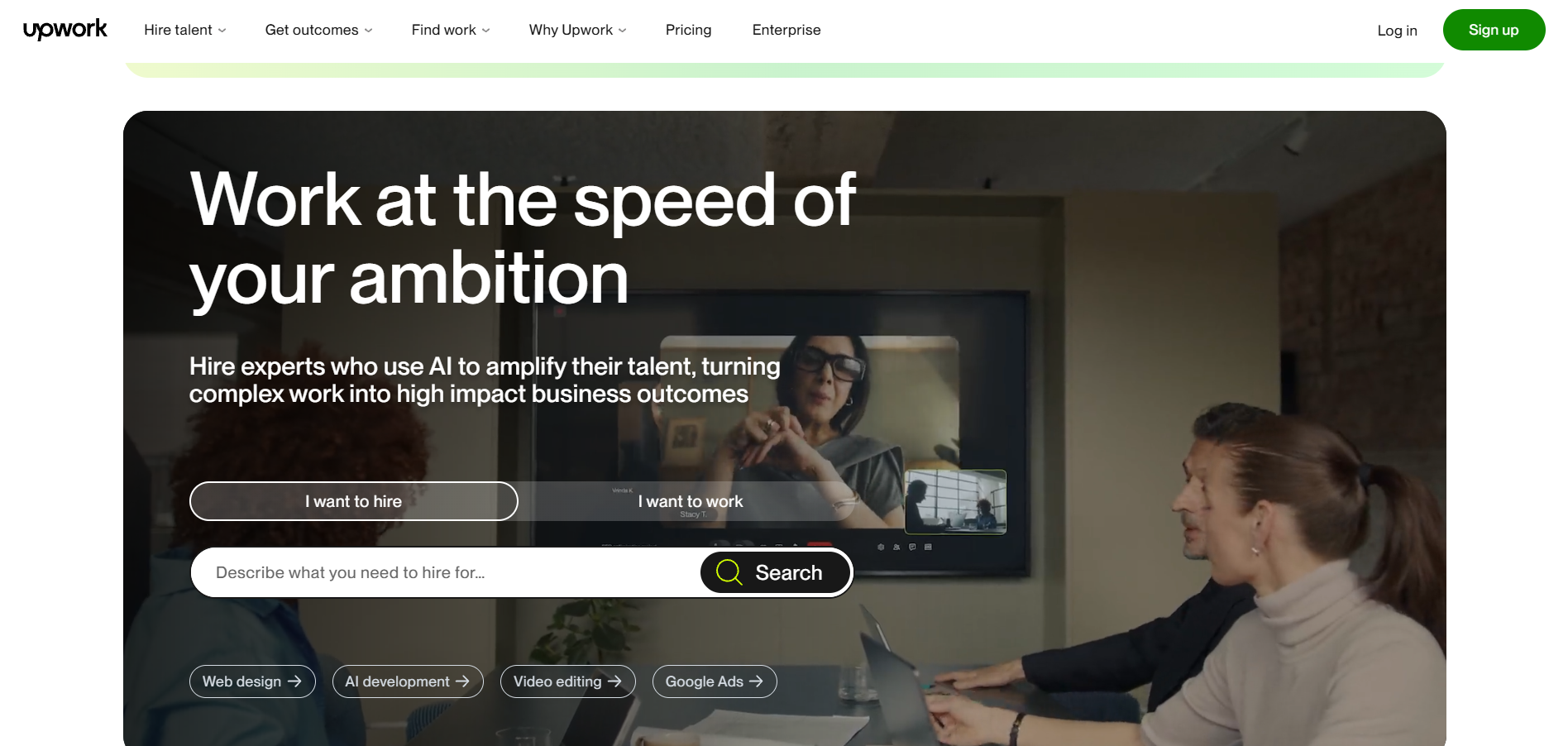
Upwork gives you the largest open pool of AI freelancers to search for yourself, with 18 million freelancers across 180 countries who set their own rates and availability. You post a role, review the proposals that come in, and can hire for anything from a two-week prototype to a build that runs for months.
To help you assess applicants, Upwork provides job description templates and interview questions for AI and machine learning roles, from LLM fine-tuning and RAG to computer vision. Your engineers can then adapt those questions to your stack and product, so each interview tests the expertise the role calls for.
Because anyone can join the marketplace for free, most freelancers reach you without any technical screening. A smaller group carries Upwork's Expert-Vetted badge after passing its own pre-vetting, and Business Plus plans give you access to them. For everyone else, Upwork's AI assistant, Uma, can interview applicants on your questions, score their answers, and attach recordings and transcripts.
None of this confirms whether a candidate has shipped and maintained an AI system in production. That check falls to your engineers, who review portfolios and code and ask how past systems held up after launch, in time taken from their own development work.
Upwork’s open marketplace pays off for teams with an engineer who can judge AI work and has time to run the screening, since they get the largest pool to choose from and set their own bar. If your engineers are already stretched, or no one on the team can assess AI work, the open marketplace leaves you with more vetting than you can cover.
What you get with Upwork
- Identity and location verification on every freelancer, plus ratings, work history, and talent badges
- Search filters for skill, experience level, location, and availability, plus direct invitations to freelancers you choose
- Interviews scheduled and held in the platform's messaging, with an instant transcript and summary
- Escrow-funded milestones, tracked hours and work activity, and mediated dispute resolution
- A catalog of more than 290,000 pre-scoped projects you can order without posting a job
Upwork Pricing
Upwork is free to post on. You pay a service fee on each payment to a freelancer, plus a contract initiation fee on each new contract.
- Basic: 5% service fee on each payment — 3% for eligible U.S. clients paying from a checking account, plus a contract initiation fee ($0.99 to $14.99) on each new contract
- Business Plus: 10% service fee on each payment — 8% for eligible U.S. clients paying from a checking account, adds access to expert-vetted talent and unlimited AI shortlisting, and waives the contract initiation fee except on contracts under $100 (up to $4.99)
Upwork Rating
- G2: 4.5/5 — based on 3,229 reviews
- TrustRadius: 8.5/10 — based on 76 reviews
5. BairesDev - Best for outsourcing an AI initiative from roadmap to delivery
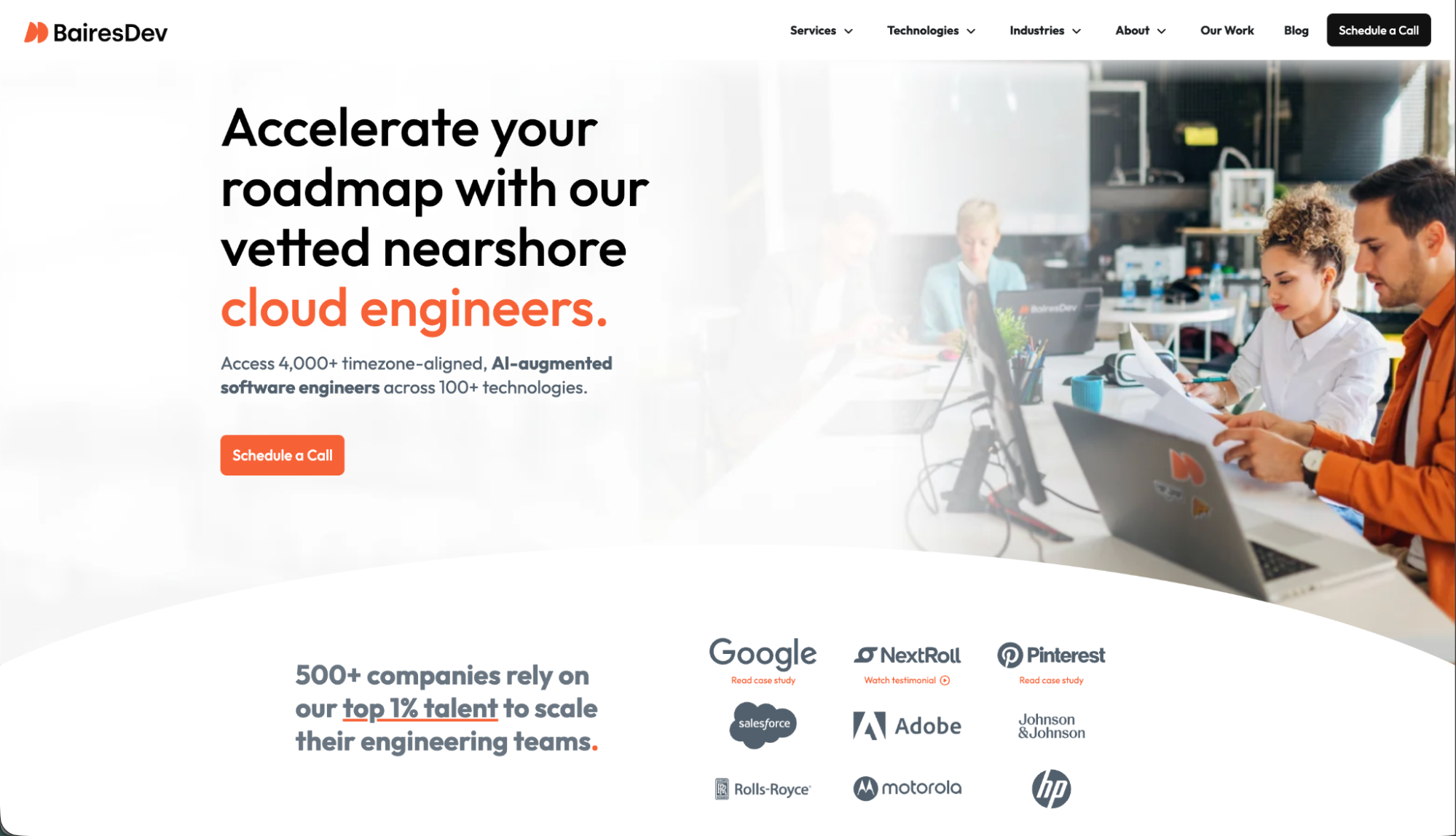
BairesDev takes on AI initiatives from planning through delivery, with its own engineers doing the build. Its AI Transformation practice starts by assessing your data, infrastructure, security, and team skills, then sets a 90-day roadmap with an outcome metric both sides agree on before development begins.
You decide how much of the work to hand over. BairesDev can supply individual engineers to work with your team, assemble a dedicated pod with a technical project manager and Scrum Master, or manage the full build.
With a full build, your team sets priorities and reviews the results while BairesDev runs development, coordinates sprints, and resolves blockers. That usually takes two to four weeks to get up and running, though, so it’s not ideal for urgent projects.
BairesDev engineers are assessed through scenario-based exercises modeled on real delivery work, such as balancing cost against performance or finding out why a model got worse after an update, followed by a technical interview with senior engineers with the same role and an understanding of AI systems.
Handing over delivery also gives BairesDev most of the say over staffing. Most clients use its direct placement, where engineers join without you interviewing them first. You can make interviews part of the engagement if you want a say in who joins, and if a placed engineer isn't right for the work, BairesDev provides another at no added cost.
If you have an AI initiative to deliver but no team free to run the build, BairesDev can take it on end to end. Its engineers stay on BairesDev's payroll, though, so if you want someone who joins your company and builds your AI systems for the long run, a direct-hire route serves that goal better.
What you get with BairesDev
- AI and machine learning teams for model development, LLM fine-tuning, RAG pipelines, and production ML infrastructure
- Senior ML engineers, data scientists, and data engineers on every machine learning engagement, with no juniors or freelancers
- ML lifecycle coverage from data pipelines and custom models through NLP, computer vision, MLOps, and model governance
- Engineers who use GitHub Copilot, Claude Code, Cursor, and other AI coding tools in daily work
- Secure AI development aligned with SOC 2, HIPAA, GDPR, and the EU AI Act, plus security audits
BairesDev Pricing
- BairesDev doesn't publish a rate card. Your engagement price comes after a discovery call and is based on scope, team size, seniority, and the services included in the contract.
BairesDev Rating
- Clutch: 4.9/5 — based on 63 reviews
- Trustpilot: 4.2/5 — based on 179 reviews
6. Lemon.io - Best for quickly hiring a senior AI contractor for sprint-based work
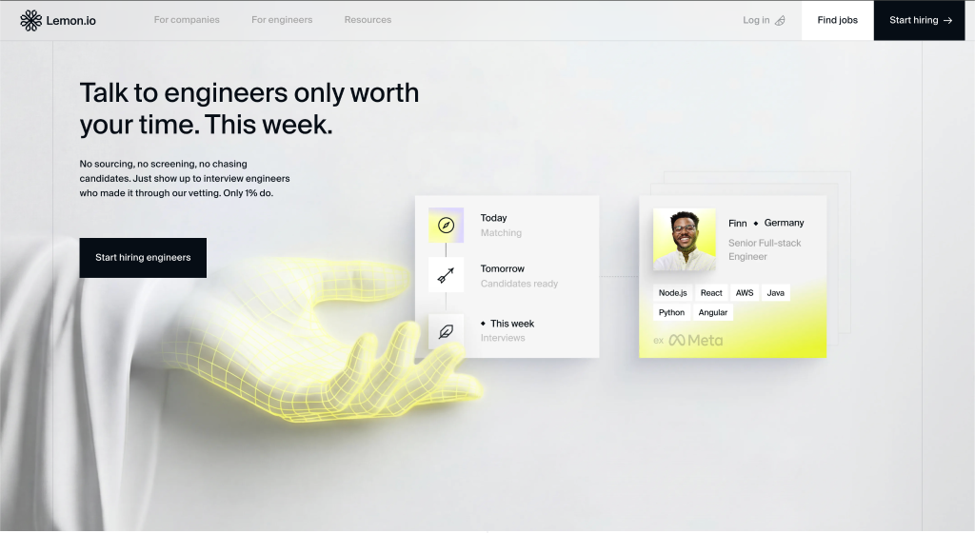
Lemon.io matches you with a senior AI contractor for work that's already scoped, with most matches arriving within 24 hours. A technical analyst reviews your requirements and shortlists one to three engineers with relevant experience, availability, and time zone, and you interview them and make the final call.
Every engineer on that shortlist has already passed a screening that ends in a live problem-solving session with a senior engineer, with a second engineer reviewing the result. The session tests how candidates reason through trade-offs and how they use AI tools in their own work, including what they hand off to AI and what they check themselves.
Once you choose someone, the contract can cover a single sprint or a longer project, since Lemon.io sets no minimum hours or contract length. If the match doesn't work out, a Lemon.io manager finds you another engineer at no extra cost.
Because Lemon.io's engineers are independent contractors, directing their work stays with your team. They supply their own equipment, and responsibility for what they deliver falls to your managers. Hiring someone permanently later also means a separate direct placement with its own terms and fee, so it’s not a great fit for known long-term positions.
For a defined piece of AI work with a lead ready to direct it, Lemon.io gets a senior engineer started quickly. A permanent hire from day one, or a vendor that owns delivery, calls for a different model than contractor matching.
What you get with Lemon.io
- A multi-stage vetting funnel ending in a live problem-solving interview with a senior engineer, peer cross-reviewed
- Developer profiles showing years of experience, availability, country, and GMT offset alongside the stack
- Full-time at 40 hours a week or part-time at 20, with the option to continue onto new projects
- Contracts, invoices, NDAs, and developer payouts handled for you, with an optional MSA for your legal team
- Hiring requests from the client dashboard or from inside a Claude conversation
Lemon.io Pricing
Lemon.io bills by the hour, with the rate set by tech stack, seniority, and scope, and you pay only for hours worked.
- Hourly engagements: $60 to $90/hr typical — full-time at 40 hours a week or part-time at 20
- Direct placement: $14,000 — a one-time fee if you hire the developer directly or pay them off the platform
Lemon.io Rating
- G2: 4.7/5 — based on 59 reviews
- Trustpilot: 4.8/5 — based on 369 reviews
7. Andela - Best for scaling an AI engineering team across build, integration, and production roles
Andela lets you grow AI engineering capacity across several initiatives, either by adding engineers to your existing teams or by bringing in a team it runs for you. Blended Teams places individual engineers inside your team, under your own managers, often within 72 hours. Managed Solutions puts an Andela-run team on a larger build, such as training an LLM or orchestrating AI agents, so your existing teams can stay focused on their projects.
Both draw on a pipeline of AI engineers that Andela trains and releases every quarter, with training in LLM applications, agent-based systems, and running AI in production. Engineers are grouped by the layer of an AI system they work on, so you can staff each one with a specialist. Builders ship LLM and agent features, Integrators connect models to the software and data you already run, and Scalers keep AI systems reliable and affordable in production.
Before joining, engineers pass an English proficiency test, a technical assessment, and a live technical interview. When you open a role, an Andela matcher shortlists candidates against your requirements, and your team interviews them and makes the hiring decision.
Unlike nearshore hires who share U.S. working hours, Andela's engineers work remotely from more than 135 countries. How many hours they share with your team depends on where each one is based. If the role involves daily standups and code reviews with your engineers, make the overlap you need a requirement when you open it.
Andela makes the most sense when AI work keeps growing across teams and you expect to add engineers in stages, whether under your own managers or as a managed team. For a single specialist on a short project, that team model brings more structure than the work needs.
What you get with Andela
- One platform for sourcing, qualifying, hiring, and paying global technologists
- Recorded playback of a candidate's coding test, with proctoring that flags window switching and external copy-paste
- Continuous assessment and reskilling of the AI-native engineers in the network
- AI system delivery beyond staffing, covering data readiness, enterprise AI retrieval, and agentic systems in production
- Training programs that upskill your own engineers on LLM engineering, agentic systems, deployment, and AI leadership
Andela Pricing
Andela doesn’t publish standard pricing for its talent or managed AI engagements. You’ll need to discuss the role, team, or project with Andela and request a custom quote.
Andela Rating
- G2: 4.7/5 — based on 1,536 reviews
8. Gun.io - Best for hiring senior AI contractors with ongoing delivery oversight
Gun.io places senior contractors on your AI project and stays involved after they start, so someone outside your team is accountable for the quality of their work. It tracks code quality and architectural drift, meaning how far the system has moved from the design you agreed on, and adjusts the team's mix of skills if your roadmap changes. If delivery falls short of the agreed standard, fixing it is Gun.io's responsibility, even if that means redeploying the team.
Each engagement opens with a review of your project's technology, constraints, and delivery risks, which sets the baseline Gun.io measures progress against. The engineers themselves pass an algorithmic screening, a review of their work history and background, and a live technical interview with a senior engineer, and most of those currently engaged have ten or more years of experience.
Because Gun.io stays between you and the developer, hiring one directly comes at a cost. You sign a two-year non-solicitation agreement before the engagement begins, so bringing a developer onto your payroll means Gun.io waiving it in exchange for a buyout fee.
Gun.io is worth the added oversight on builds where drifting from the plan would be expensive and you want someone outside your own management answering for the result. Teams whose managers want to direct a contractor themselves won't use much of that oversight, and since most developers on the platform prefer contract work, it's a harder place to find someone to employ long term.
What you get with Gun.io
- Machine learning developers for deep learning, neural networks, business intelligence, and statistical data analytics
- Developers based across North America, South America, Central America, Europe, and Asia
- Multi-currency payroll and tax compliance across more than 100 countries
- Hours tracking, billing, and payments handled through the platform
- A client success manager and talent advocate on each engagement, with weekly worklogs and check-ins
Gun.io Pricing
Gun.io doesn't have standard prices. Contract work is billed at each developer's hourly rate, shown on their profile, through one of two arrangements, and full-time placements carry a one-time fee.
- Monthly retainer: a recurring share of the developer's time, booked each month
- Accelerate package: a single block of hours for shorter projects, topped up as needed
- Full-time placement: 20% of the first year's negotiated base salary — a one-time fee
Gun.io Rating
- G2: 4.5/5 — based on 16 reviews
- Trustpilot: 2.2/5 — based on 8 reviews
9. Braintrust - Best for screening AI engineering candidates across multiple open roles
Braintrust uses AI to screen and rank candidates, which helps most when you have several AI roles open and not enough engineer time to review every applicant. For each role, it narrows a network of more than two million professionals to five ranked candidates, usually within 48 hours. You can hire someone onto your existing team, staff a squad for a project, or start on contract and convert the hire later.
The screening starts before any role opens. Professionals earn a Certified Braintrust Talent badge by building a structured profile, verifying their identity, and completing a 15- to 30-minute AI interview in their field. Certified members rank higher when the matching engine searches for your role, down to specializations such as LLM fine-tuning and MLOps.
Shortlisted candidates then record an asynchronous AI video interview, which produces a scorecard in place of a first screening call. The scorecards make candidates easy to compare, but every judgment up to that point comes from AI interviews, so none of it shows how a candidate built or ran a real system. Your engineers usually have to review their shipped projects themselves once the list arrives.
Braintrust saves the most time when you're filling several AI roles at once. For a single senior hire, your engineers will likely want to dig into the candidate's production experience themselves, which leaves less for Braintrust's screening to take off their plate.
What you get with Braintrust
- A network working across software, AI, data, and engineering, with a quarter of members in the United States
- Rank, search, sort, and real-time feedback controls over the candidates matched to your role
- Employer of Record coverage in over 150 countries, with background checks, onboarding, and worker classification handled
- Global contractor payroll, invoicing, and expense management, paid in local currency
- A SOC 2 Type II compliant platform
Braintrust Pricing
Braintrust adds a platform fee (15%) on top of every payment to a professional you work with through it. Employer of Record and payroll services cost extra.
- Conversion fee: 15% of first-year base salary — when you hire a professional as an employee before six months of work through Braintrust, with no fee after six months
- Direct hire fee: 15% of first-year base salary — for each direct-hire placement
Braintrust Rating
- G2: 4.5/5 — based on 914 reviews (listing for its AI recruiting software)
- Trustpilot: 1.7/5 — based on 19 reviews
10. Proxify - Best for scaling senior AI engineering capacity on a flexible monthly contract
Proxify gives you senior AI, machine learning, and data engineers on a monthly contract that grows or shrinks with the work, starting at 40 hours a month. You can add hours as the workload grows, resize the team with a month's notice, or move an engineer onto your payroll when you're ready, so you don't commit to a full-time hire before the work justifies one.
Engineers are vetted before they join the network, through a timed coding assessment and a live interview with a senior Proxify engineer that includes pair programming and problem-solving walkthroughs. For your role, a 25-minute call covers your stack, team, and timeline. Proxify's matching engine, Eros, then weighs skills, time zone, past performance, and soft skills to present one to three profiles, usually within two days, and you interview the ones you want to meet before approving the match.
Because Proxify's engineers are contractors who can roll off when an engagement ends, what they learn about your systems can leave with them. Keeping it means your technical lead documents architectural decisions, reviews the code, and makes sure the rest of the team understands how things were built. Otherwise, whoever comes next spends their first weeks rebuilding that context.
When you need senior AI expertise now but can't yet predict the hours, Proxify's monthly terms let capacity follow the workload. You keep control of the engineer's daily work and the project's technical direction, but if one becomes central to a system you rely on, keeping them for good means paying to move them onto your payroll. If you'd prefer hands-off delivery, Proxify’s arrangement leaves too much with your team.
What you get with Proxify
- Vetted data and AI engineers in a network of 6,000+ professionals across 1,000+ tech competencies
- PyTorch, TensorFlow, Hugging Face Transformers, MLOps, and Databricks among 240+ data and AI competencies
- An English assessment and HR interview on every candidate before you see their profile
- An ISO 27001 certified platform with contracts built for UK IR35 and Dutch DBA Act rules
- A technical contact and an account manager supporting onboarding, HR, and admin throughout the engagement
Proxify Pricing
Proxify charges a monthly rate per engineer ($5,600 to $8,800 for a senior engineer at 40 hours a week), set by skills, seniority, and hours (minimum 40 hours a month). There are no upfront recruitment or contract fees, and if you're not satisfied after the first week, that week is free.
Proxify Rating
- Trustpilot: 4.5/5 — based on 325 reviews
11. Fiverr Pro - Best for commissioning a defined AI deliverable from a vetted freelancer
Fiverr Pro lets companies commission a specific piece of AI work, such as a chatbot, automation script, or model prototype, without opening a role on their engineering team. Freelancers and agencies in its Pro catalog are reviewed before acceptance, based on portfolio quality and ratings earned both on and off the platform.
If you know what you need built, you can search the catalog for relevant AI expertise and contact providers directly. Each order covers an agreed scope of work, so you can commission a deliverable without committing to an ongoing engagement.
If you need help finding the right provider, a Fiverr domain expert can take your requirements, search the platform and external sources, and interview potential providers. From that, you receive a report with recommendations, usually within five business days. If none fit, Fiverr runs another search.
The downside of Fiverr's order-based model is that repeated work with the same freelancer can start to look like employment. If one person keeps building and maintaining your AI work under your direction and is later classified as an employee, your company carries the legal obligations. Fiverr's paid plans include a worker classification audit that rates the relationship as Low Risk or High Risk, but a High Risk result doesn't pause or end the engagement, so acting on it is up to you.
For a one-off AI task you can define up front, Fiverr Pro gets it built without opening a role, signing an employment contract, or bringing in a sourcing firm, and you pay only once you've approved the finished work. Once the work turns into ongoing development or maintenance that your team directs, a hire who joins your team is usually the better long-term answer.
What you get with Fiverr Pro
- A catalog of AI developers, machine learning and deep learning experts, chatbot developers, and automation specialists
- Filters for hourly rate, budget, language, freelancer location, and consultation availability
- An AI-guided intake that builds the job description from a chat and returns a shortlist within hours
- Payments held and released to the freelancer only after you approve the work
- Background checks in 200+ countries and territories, plus e-signed NDAs and SOWs
Fiverr Pro Pricing
Fiverr adds a service fee to every order (5.5% of the purchase, plus $3.50 on orders under $200). Pro access comes in three plans, and expert sourcing is priced per request.
- Essential: $0 for the first year — kept after that by ordering $1,000 or more in services a year, with the vetted catalog, a money-back guarantee, and shortlisting by Pro experts
- Advanced: $129/month — adds a business success manager, legal document management, and one background check and worker classification audit a month
- Enterprise: a custom plan for running freelance hiring across an organization
- Expert sourcing: $199 per request — a domain expert sources, interviews, and recommends freelancers for one project
Fiverr Pro Rating
- G2 (Fiverr): 4.3/5 — based on 463 reviews
- Trustpilot (Fiverr): 2.5/5 — based on 14,910 reviews
What type of channel should you use to hire AI engineers?
The eleven sites above fall into five types of hiring channels. Each type splits the work differently between you and the provider, from finding and screening candidates to employing the engineer and managing the work, so knowing the type tells you how much of the hiring stays with your team.
Nearshore dedicated-hire platforms
Nearshore dedicated-hire platforms like Strider source and screen candidates in time zones close to yours, then employ the one you choose to work for your team full-time. The platform handles contracts, payroll, and local compliance, while your managers direct the work. This channel is built for roles you expect to keep, such as maintaining a production model or owning a data pipeline.
Vetted talent networks
Vetted talent networks like Toptal, Arc.dev, Lemon.io, and Proxify test engineers before they join, usually through expert interviews or live coding, then match a few against your requirements. Most of their engineers work as contractors, so you get specialized expertise for a defined project without making a permanent hire.
AI staffing and matching platforms
AI staffing and matching platforms such as Braintrust let software handle the first rounds of screening, so you can focus on engaging only qualified candidates. Each completes AI interviews, and automated matching ranks them for each role, which speeds things up when you're filling several roles with similar skills or hiring the same profile again.
Freelance marketplaces
Freelance marketplaces like Upwork and Fiverr Pro connect you directly with independent engineers. You post the work or search the catalog, and screening, selection, and the terms of the work are yours to handle. They work well for a short prototype or a task precise enough to price, as long as someone on your team can judge the results.
Staff augmentation and managed engineering providers
Staff augmentation adds engineers to your existing team, and you manage them. Whereas a managed engineering provider gives you a whole team and manages the work for you.
Choose staff augmentation when you need more engineers and already have the leads to manage them, and managed delivery when you want the provider to run an AI project from start to finish, usually including engineer selection as well.
Practically, the real difference between these models is how much control you keep and how much you delegate.
How to choose the right site to hire AI engineers
The channel type sets how the work is split. Within a channel, sites still differ in who employs the engineer, how they screen for AI work, and what support continues after the hire.
Take these steps to narrow down your own shortlist.
Decide the hiring model you need
Who employs the engineer decides what your team handles after the hire.
A contractor keeps the commitment short, but worker-classification questions stay with you. An Employer of Record (EOR) or staff augmentation provider takes on the employment, and with an EOR, the engineer works only for your team.
The employee or contractor choice also matters if the role turns permanent. Some sites let you move a contractor onto your payroll after a notice period or for a fee, while others give you an employee from the start. Check those terms before you begin with a contractor you might want to keep.
Define the AI work the engineer will own
AI engineer is a broad title, and the skills you need depend on the work the engineer will do.
- LLM and RAG applications: Look for retrieval design, context handling, and a record of evaluating output quality in production.
- AI agents and workflow automation: Test how the candidate handles tool use, orchestration, and a step that fails mid-run.
- Machine learning models: Ask for feature work, training, and evaluation on data like yours.
- NLP or computer vision: Assess hands-on experience with domain-specific tasks, including data preparation, model selection, and evaluation.
- MLOps and LLMOps: Screen for deployment, drift monitoring, and keeping cost and latency in check.
- AI infrastructure: Probe the data pipelines, compute, and serving layer the models run on.
An engineer who has run LLM applications in production may never have trained a model. An MLOps engineer may never have written a production prompt. Pick the one or two areas the role depends on before you compare how sites screen.
Compare how sites screen for AI work
A general coding test won't tell you whether someone can build an LLM application or keep an AI system running in production.
Look for an assessment built around the work you've defined, then check who makes the technical call. An engineer from the same field, a recruiter, and an automated AI interview each catch different things. Knowing which one decided tells you how much your own engineers still need to check.
Each format has blind spots. A test project shows how someone works on a realistic problem, but it takes days or weeks. A take-home is quicker to run, though the work could come from the candidate, an AI coding agent, or both.
A live coding interview lets the interviewer ask why the candidate chose an approach and what constrained it. Those follow-up questions make AI-generated answers harder to pass off. They also show how well the engineer uses AI in their own work.
Whatever the format, ask what evidence reaches you, whether it's a scorecard, a written assessment, a recording, or only a pass. The more you see, and the more qualified the reviewer, the less screening your engineers have to repeat.
Decide how much hiring support you need
Compare what each site hands your team, whether that's a ranked shortlist, a few matched profiles, or open proposals to sort. Applicant volume slows hiring down, since screening is where most of the hiring time goes. The more of it a site does before candidates reach you, the less your team does.
Then check what happens after the start date. Some sites step back once the contract is signed. Others stay on for onboarding, payroll, check-ins with the engineer, or oversight of the delivery, and that support is part of what you're comparing.
Check team fit and working style
How much real-time overlap you need depends on the engineer's role on your team. An engineer building a standalone component can work from async updates, while one who owns part of your product takes part in your planning, standups, and code reviews, which only works when your working hours line up.
Before you compare sites, answer these:
- How many hours of overlap does the work need each day?
- Will the engineer work directly with product or leadership?
- Will they join planning, standups, and reviews?
- How often will the team need to make decisions together?
Four hours of shared time can turn a code review from a two-day wait into a same-day conversation. Most sites match or filter by time zone, so state the overlap you need as a requirement from the start.
Compare total hiring costs
Don't compare rates alone. A lower rate can leave more of the work with your team, from sourcing candidates and running technical interviews to handling employment, equipment, and payroll. A higher rate may include those services.
Compare each option over the length of the engagement. Count your team's hiring time, platform or placement fees, any fee to convert a contractor to a full-time hire, and the costs that continue after the engineer starts. Starting over has a cost too, so check what each site does when a match doesn't work out.
Strider: Keep the engineer who knows how your AI system was built
AI work rarely ends at launch. Once a system is live, the data behind it keeps changing, so models need retraining and the features built on them need updating to match. Each update also has to work with choices made when the system was first built. The engineer who made those choices can pick up where they left off, while someone new has to work them out from the code first.
Most of the channels above make that engineer hard to keep. A contractor can move on to the next client when the engagement ends, and an engineer on a vendor's staff stays tied to that vendor's contract, so keeping either one long term means a conversion fee or setting up employment in another country yourself.
Strider matches you with AI-fluent engineers in Latin America and employs the one you choose as their Employer of Record. A full-time hire works only for your company for as long as you need them, and your managers direct the work from the first day.
Being on your team also changes how the AI gets built. As the product grows, the same questions keep coming back, such as what a model should optimize for, how much error users will tolerate, and when an output needs a human check. With four to eight hours of daily overlap, your engineer works through them with your product and engineering leads in the same standups and reviews as the rest of your roadmap.
Book an intro call and bring the AI role you're hiring for. You'll get four or five matched AI engineers within two days, and it's free until you hire.